
Last Updated on April 7, 2026
Space issues in Los Angeles rarely appear overnight. They usually start with a small shift—a home office, a family member moving in, or the idea of earning rental income from unused space. That’s when the real decision starts: do you expand your current home, or build something separate on your property?
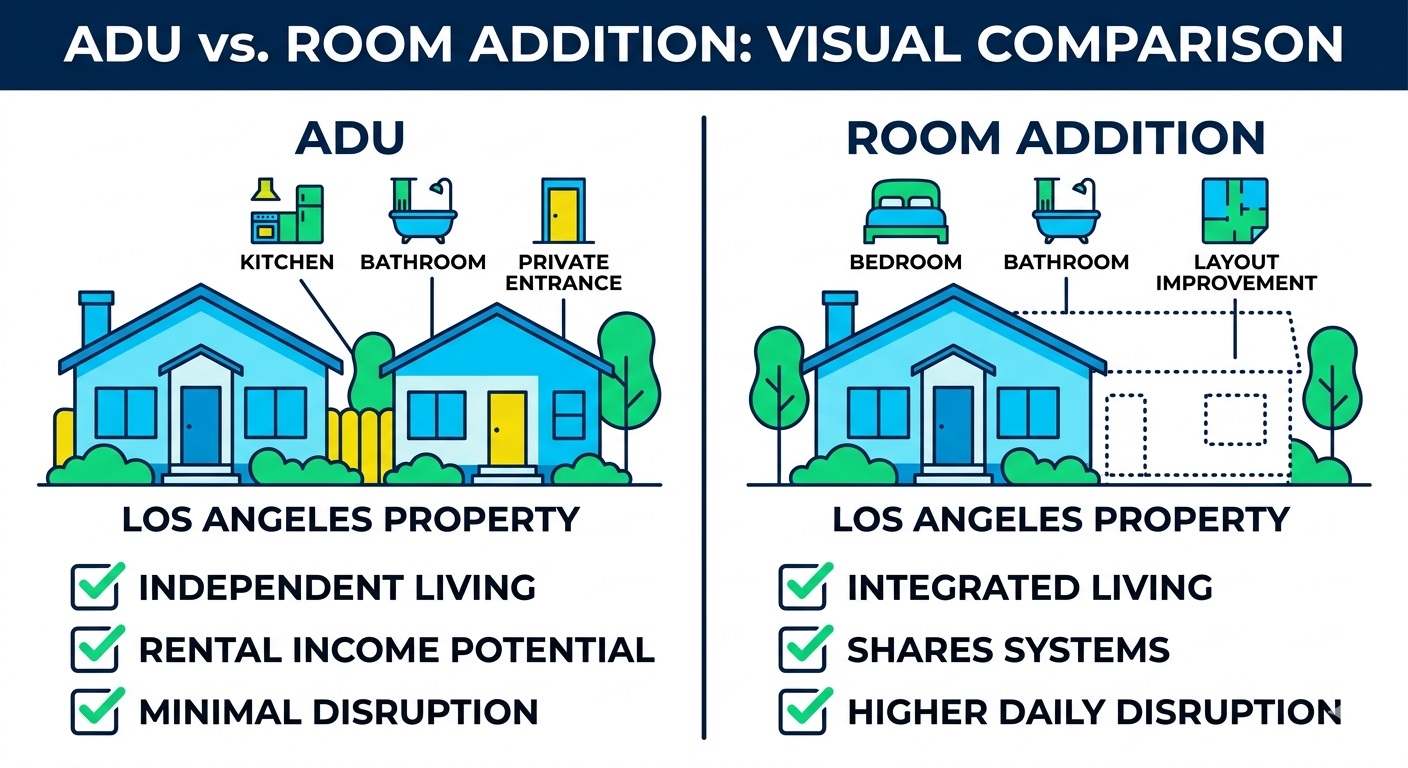
Understanding the functional differences: Is your goal a separate income-generating unit (ADU) or integrated living space (Room Addition)?
Both Accessory Dwelling Units (ADUs) and room additions increase square footage, but they behave very differently once completed—financially, structurally, and in how they’re used. The choice directly affects how the space functions day to day, how much disruption construction causes, and how the property performs in Los Angeles’ resale and rental markets.
Contents
- What is an ADU in Los Angeles?
- What is a Room Addition? What Is a Room Addition in Los Angeles?
- Common Mistakes When Choosing ADU vs Room Addition
- How to Choose Between an ADU and a Room Addition
- ADU vs Room Addition: Side‑by‑Side Comparison
- Common Misconceptions About ADUs and Room Additions in Los Angeles
- Real Cost Scenarios in Los Angeles: ADU vs Room Addition
- ADU vs Room Addition Timeline in Los Angeles
- ADU vs Room Addition Permit Process in Los Angeles
- Final Verdict: Should You Build an ADU or a Room Addition?
- Choosing the Right Builder in Los Angeles
- ADU vs Room Addition FAQs
What is an ADU in Los Angeles?
An Accessory Dwelling Unit (ADU) is a fully independent residential unit built on the same lot as your primary home, with its own entrance, kitchen, bathroom, and living area. For the formal statewide definition and policy background, the California Department of Housing and Community Development’s official ADU page and updated ADU handbook are the go‑to references.
In California, ADUs are governed by statewide laws administered by HCD, which cities like Los Angeles must follow and integrate into their local codes. In Los Angeles, common ADU types include:
- Detached backyard units
- Attached ADUs with separate access
- Garage conversion ADUs
- Junior ADUs (JADUs) created within the existing footprint
From a practical standpoint, an ADU behaves like a secondary housing unit, not just extra space. That distinction matters because it means the ADU can generate rental income, support multi‑generational living, and operate independently from the main house.
ADU Cost Basics in Los Angeles (2026)
Cost expectations are often misunderstood. While garage or existing-structure conversions can significantly reduce costs, ground‑up ADUs in Los Angeles typically range from about $250–$450 per sq. ft. in 2026, depending on utilities, site conditions, and design complexity. Many projects fall in the $300–$400 per sq. ft. band, with total costs for a detached 400–800 sq. ft. ADU commonly lands between roughly $150,000 and $350,000.
If you want a deeper dive into numbers, materials, and allowances, see the dedicated guide on the cost to build an ADU in Los Angeles. For owners focused on budget control, this checklist on minimizing ADU construction costs is a useful companion.
What is a Room Addition? What Is a Room Addition in Los Angeles?
A room addition expands your existing home by adding square footage directly to the primary structure, rather than creating a separate unit. That can mean adding bedrooms or bathrooms, extending kitchens or living areas, or building outward on the ground floor or upward with a second‑story addition.
Unlike an ADU, a room addition depends entirely on your existing structure, which introduces constraints around foundation capacity, load‑bearing walls, and extending systems like plumbing, HVAC, and electrical. Because work happens inside or immediately adjacent to your living area, construction is more intrusive and often impacts daily routines for several months.
The trade‑off is integration: the added space becomes part of your everyday layout and improves how your home functions without creating a separate dwelling unit or triggering independent‑unit zoning considerations. If you’re still early in planning, it can help to compare this with a full‑scale remodel using a broader guide like home remodeling costs in Los Angeles.
Common Mistakes When Choosing ADU vs Room Addition
Most homeowners in Los Angeles misjudge this choice by comparing ADUs and room additions only on cost per square foot. That comparison misses the real difference.
- An ADU functions as a separate property asset that can be rented, used by family, or adapted independently over time.
- A room addition functions as a direct extension of your home that improves daily living without creating a standalone unit.
A more useful way to evaluate the decision:
- If the goal is rental income, privacy, or independent living, an ADU usually aligns better.
- If the goal is more usable space within your current layout, a room addition typically makes more sense.
In Los Angeles—where rental demand and property values are closely tied to how space can be used—this distinction has long‑term financial impact, not just design implications.
How to Choose Between an ADU and a Room Addition
The better way to compare an ADU and a room addition is by the problem you’re actually trying to solve.
1. Define the Purpose of the New Space
Everything flows from the purpose.
- If you need independent living space, an ADU fits naturally because it allows separation between occupants, which is why it’s commonly used for rental income, aging parents, or long‑term guests.
- If you need to improve how your current home functions, a room addition is usually more appropriate – you’re fixing space limitations inside your existing layout, not creating a second unit.
A simple way to frame it:
- ADU → independent use (rental, privacy, separate living)
- Room addition → integrated use (family space, layout improvement)
If you’re not sure whether an ADU is worth it in the first place, this separate breakdown on how much value an ADU adds can help clarify the upside.
2. Compare Costs and Long‑Term Return in Los Angeles
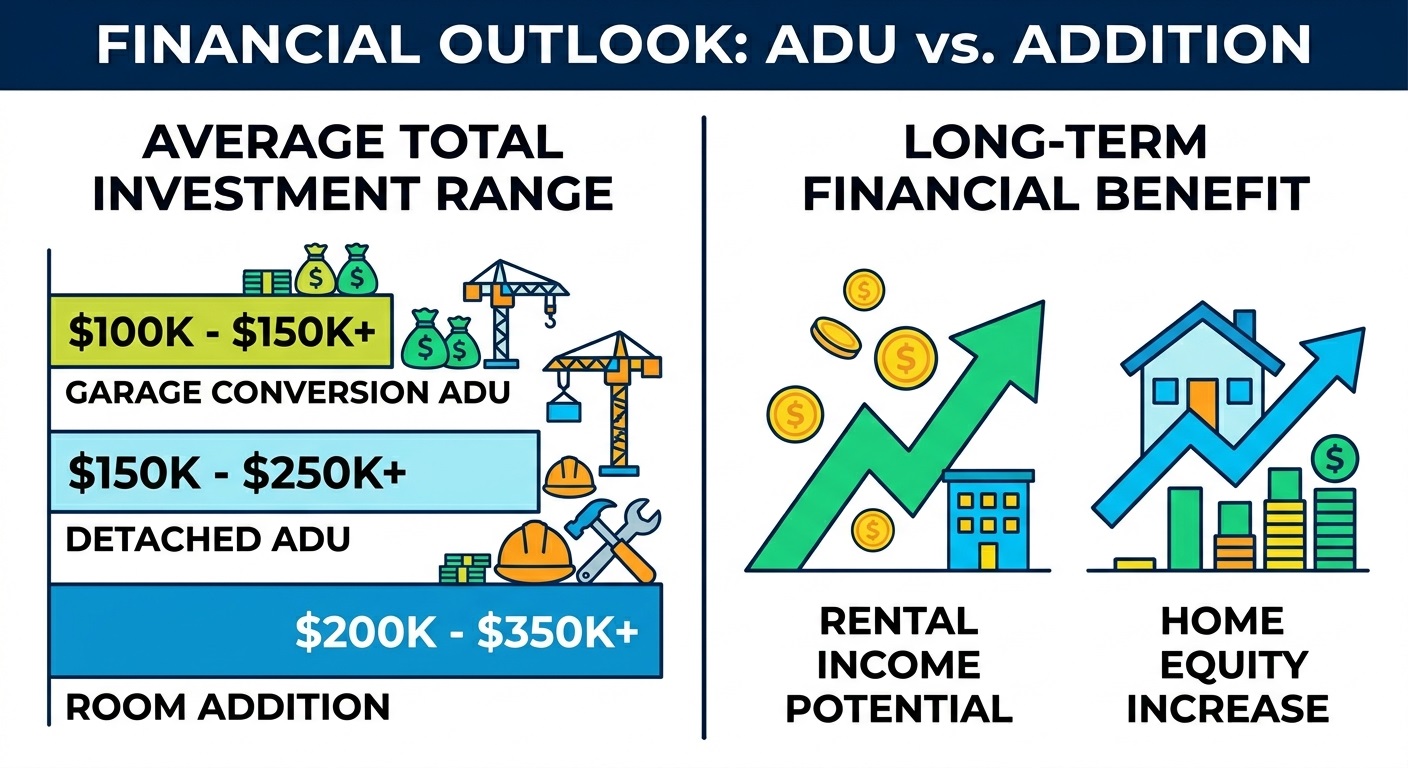
While initial investments vary, the primary difference lies in the long-term return: ADUs offer passive income, while additions maximize resale value through livability.
Construction costs in Los Angeles are rarely straightforward; two projects with similar square footage can behave very differently financially.
- ADU costs: Ground‑up ADUs typically run about $250–$450+ per sq. ft., or roughly $150,000–$350,000+ depending on size, finishes, utilities, and site work. Garage conversions can be significantly less because the shell already exists.
- Room addition costs: Room additions in Los Angeles often range from about $200–$600+ per sq. ft., with basic room additions sometimes coming in around $125–$250 per sq. ft. for simpler projects and higher for kitchens, baths, and second stories.
The real difference shows up after construction:
- An ADU can generate ongoing rental income, meaning the project behaves like an income‑producing asset over time. For tax treatment and reporting of residential rental income, see the IRS summary of Publication 527 or the IRS site itself.
- A room addition does not produce direct income—it increases property value through livability, additional bedrooms or bathrooms, and better layout.
If you’re cost‑sensitive and considering converting an existing structure, the focused post on the cost to convert a garage to an ADU is a useful point of reference.
3. Consider Construction Impact on Daily Life
The lived experience of construction is different for ADUs and room additions.
- Room additions happen within or directly attached to your existing home, which usually means walls opened, systems rerouted, and daily disruption for several months. Many owners continue living in the house during this time, accepting noise, dust, and periodic loss of certain rooms.
- ADUs are typically built in the yard or within a detached structure, so most of the work is off to the side or, for prefab/modular options, partly off‑site. The main home stays largely functional until the final utility tie‑ins.
If you like to see a realistic breakdown of how an ADU build actually unfolds, the dedicated ADU construction timeline article walks through phases, inspections, and typical delays.
4. Think About Space, Layout, and Flow
An ADU adds separate usable space; a room addition improves existing usable space.
With an ADU:
- You create a second living environment.
- Movement between spaces is intentional, not seamless.
- Privacy is naturally built in because the unit stands alone.
With a room addition:
- The space becomes part of your daily flow.
- Layout continuity improves within the main house.
- You don’t duplicate full kitchens or full utility systems.
In Los Angeles, where lot sizes and setbacks can be tight, this often comes down to whether you have enough yard for a detached structure versus better potential for interior or second‑story expansion. If you’re weighing other “extra space” options, this comparison of ADU vs tiny home offers another angle on how different space types function.
5. Understand Zoning, Permits, and LA Rules
This is often where projects slow down.
ADUs in Los Angeles are supported by California state law, with HCD setting baseline rules that local jurisdictions must follow. You can see how the State frames ADU policy in HCD’s official ADU overview. Locally, the City of Los Angeles implements these rules through its ADU ordinance and standards; the Los Angeles Department of Building and Safety’s ADU page is the primary technical reference for local requirements and standard plans.
Recent updates require many ADU applications to be reviewed within 60 days, and cities can offer pre‑approved plans to speed things up. However, site‑specific factors still matter, including setbacks, lot coverage, lot size, utility access, and—sometimes—parking.
Room additions follow a more traditional permitting path and must comply with:
- Local building codes and structural requirements
- Zoning limits tied to floor area ratio (FAR), height, and setbacks
- Energy and seismic standards, which are strict in Los Angeles’ earthquake zone
If you’re specifically evaluating feasibility for an ADU, the more detailed guide on the ADU permit process in Los Angeles and the breakdown of ADU permit costs in Los Angeles can help you see the permit side clearly before you commit.
6. Plan for Privacy and Future Flexibility
Privacy becomes a deciding factor faster than most people expect.
- A room addition, even with a separate entrance, still shares walls and systems with the main house, which limits acoustic and functional separation between occupants.
- An ADU, by design, creates distance—physically and functionally.
That’s why ADUs in Los Angeles are frequently used for rental tenants, extended family living, and home offices that require isolation. An ADU can change roles over time—rental unit, guest house, studio, workspace—without altering the main home, while a room addition is more fixed to the purpose it was designed for.
For flexibility examples and use‑case ideas, the article on the pros and cons of building an ADU is a helpful complement.
7. Estimate Property Value Impact in Los Angeles
Both options increase property value, but not in the same way.
- An ADU adds value through a second livable unit, rental income potential, and appeal to multi‑generational or investor‑minded buyers.
- A room addition adds value through increased square footage, improved functionality, and better appeal for larger households focused on everyday space.
If long‑term financial performance is central to your decision, the post on LA County ADU taxes is worth reviewing so you understand how a new unit may affect your property tax picture.
ADU vs Room Addition: Side‑by‑Side Comparison
| Factor | ADU (Accessory Dwelling Unit) | Room Addition |
| Primary use | Independent living space (rental unit, guest house, multi‑generational living) | Expands existing home for daily use (bedrooms, kitchen, living space) |
| How it functions | Separate unit with its own entrance, kitchen, and often dedicated utilities | Fully integrated into the main house and its systems |
| Typical cost in Los Angeles (2026) | ~ $250–$450+ per sq. ft. depending on design, utilities, and site work | ~ $200–$600+ per sq. ft. depending on type and structural complexity |
| Total budget examples | Garage conversion: often ~$90,000–$180,000 depending on size and finishes | 20×20 room addition: roughly $50,000–$100,000 on average |
| Return on investment | Can generate rental income and act as a separate asset | Increases resale value via added square footage and livability |
| Construction impact | Minimal disruption to main house (work mostly in yard or existing detached structure) | High disruption (construction occurs inside/attached to home) |
| Typical timeline | Design/permits ~1–3 months; construction ~3–6 months for many projects | Design/permits ~1–3+ months; construction ~4–9+ months, especially for multi‑room or second‑story projects |
| Zoning & permits | Backed by California ADU laws and HCD guidelines; 60‑day review target in many cases | Subject to local zoning, FAR, and structural approvals without special ADU protections |
| Privacy | High—completely separate living environment | Limited—shared walls and systems |
| Flexibility over time | Can be repurposed (rental, office, guest unit) without changing main home layout | More fixed use based on original design |
| Property value impact | Adds value via income potential plus extra unit | Adds value via increased living space and usability |
| Best for | Owners wanting income, privacy, or separate housing options | Families needing more space within their existing home |
If you’re still torn after comparing, you might also find it useful to read how ADUs compare to other property types, like this breakdown of duplex vs ADU.
Common Misconceptions About ADUs and Room Additions in Los Angeles
Clearing these up early can save time, money, and redesigns.
- Misconception: “ADUs Are Always Cheaper Than Room Additions”
Garage conversions can be relatively affordable, but ground‑up ADUs in Los Angeles often require new utility connections, site preparation, and full structural planning. These factors can push costs equal to—or higher than—some room additions on a per‑square‑foot basis. The difference is not cost alone, but the independent unit and income potential you get in return.
- Misconception: “Room Additions Are Simpler Than ADUs”
Working within an existing home introduces complexity. Structural tie‑ins, foundation upgrades, and systems extensions (plumbing, HVAC, electrical) often make room additions technically demanding, and construction is more intrusive because work happens inside the home. So while the structure exists, integration is not always straightforward. For a broader renovation perspective, you can also compare this to a full home overhaul in the article on what a full home renovation includes.
If you’re in the hiring phase, the Los Angeles County Department of Consumer & Business Affairs has a practical checklist on hiring a contractor and verifying licenses with the California Contractors State License Board.dcba.lacounty
- Misconception: “ADUs Are Only for Rental Income”
Rental income is just one use case. In Los Angeles, ADUs are commonly used for multi‑generational living, private home offices, and long‑term guest housing. The key advantage is independence: the unit can function separately without disrupting the main house. If you’re on the fence about adding an ADU at all, the post on 5 reasons to consider an ADU is a good quick read.
- Misconception: “All Added Square Footage Adds Equal Value”
Not all square footage is valued equally. A room addition increases value by improving livability—more bedrooms, better layout, and usable space. An ADU increases value differently by adding a second functional unit, which can greatly appeal to buyers interested in rental income or flexible living arrangements.
- Misconception: “You Can Build an ADU or Addition Anywhere”
Feasibility depends on zoning, lot size, setbacks, and layout. ADUs are supported by statewide housing laws, but site constraints still apply; room additions must follow structural limits and local zoning rules tied to floor area, height, and setbacks. In practice, many homeowners don’t purely choose between the two—their property determines what’s realistically possible. If you’re at the feasibility stage, the checklist for building an ADU in Los Angeles can help you quickly assess if an ADU is even viable on your lot.
Real Cost Scenarios in Los Angeles: ADU vs Room Addition
Cost ranges are abstract; scenarios make them real.
Scenario 1: Garage Conversion ADU vs Bedroom Addition
A garage conversion ADU is often the lowest entry point into creating a separate unit because the basic structure already exists. In this case, most of the cost goes into interior build‑out, plumbing and electrical upgrades, insulation, and bringing the space up to code.
- Typical garage conversion ADU budgets in Los Angeles often land around $90,000–$180,000, depending on condition, size, and finish level.
- A comparable bedroom addition can run $50,000–$150,000+ once you factor in new foundation, framing, roofing, and utilities, especially if structural work is required.
For a deeper look at this specific path, see the detailed guide on ADU garage conversion and the separate breakdown of garage conversion costs for living spaces.
Scenario 2: Detached ADU vs Multi‑Room Addition
A detached ADU is closer to building a small home from the ground up. Costs typically range from about $200,000 to $400,000+ in Los Angeles, depending on size, design, and site preparation, with utility connections and permitting complexity pushing numbers higher.
A multi‑room addition (for example, two bedrooms plus a bathroom) can fall into a similar total range when structural reinforcement, second‑story work, or major system upgrades are needed. The difference is not price so much as function: a detached ADU creates a second living unit; a multi‑room addition expands the main house.
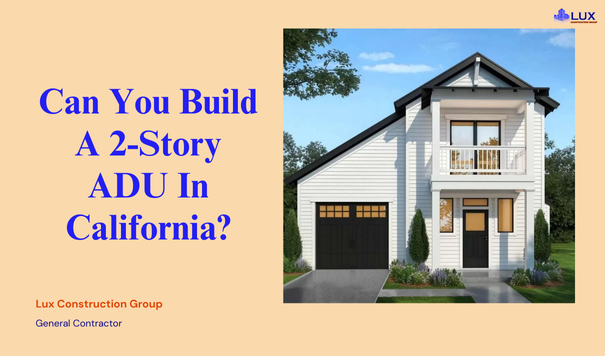
If you’re exploring other ways to add density, the article on building a 2‑story ADU in California is helpful for understanding when going vertical with an ADU makes sense.
Scenario 3: Long‑Term Financial Outcome (ADU vs Addition)
This is where the paths diverge most.
- An ADU can generate monthly rental income, which offsets construction costs and can significantly improve long‑term ROI in a high‑rent market like Los Angeles.
- A room addition does not generate direct income; its value comes from improved livability, added square footage, and stronger resale appeal to families.
If you’re also considering short‑term rentals, the post on whether you can Airbnb your ADU covers key regulatory and financial considerations; always cross‑check with local short‑term rental rules and the City’s own guidelines.
ADU vs Room Addition Timeline in Los Angeles
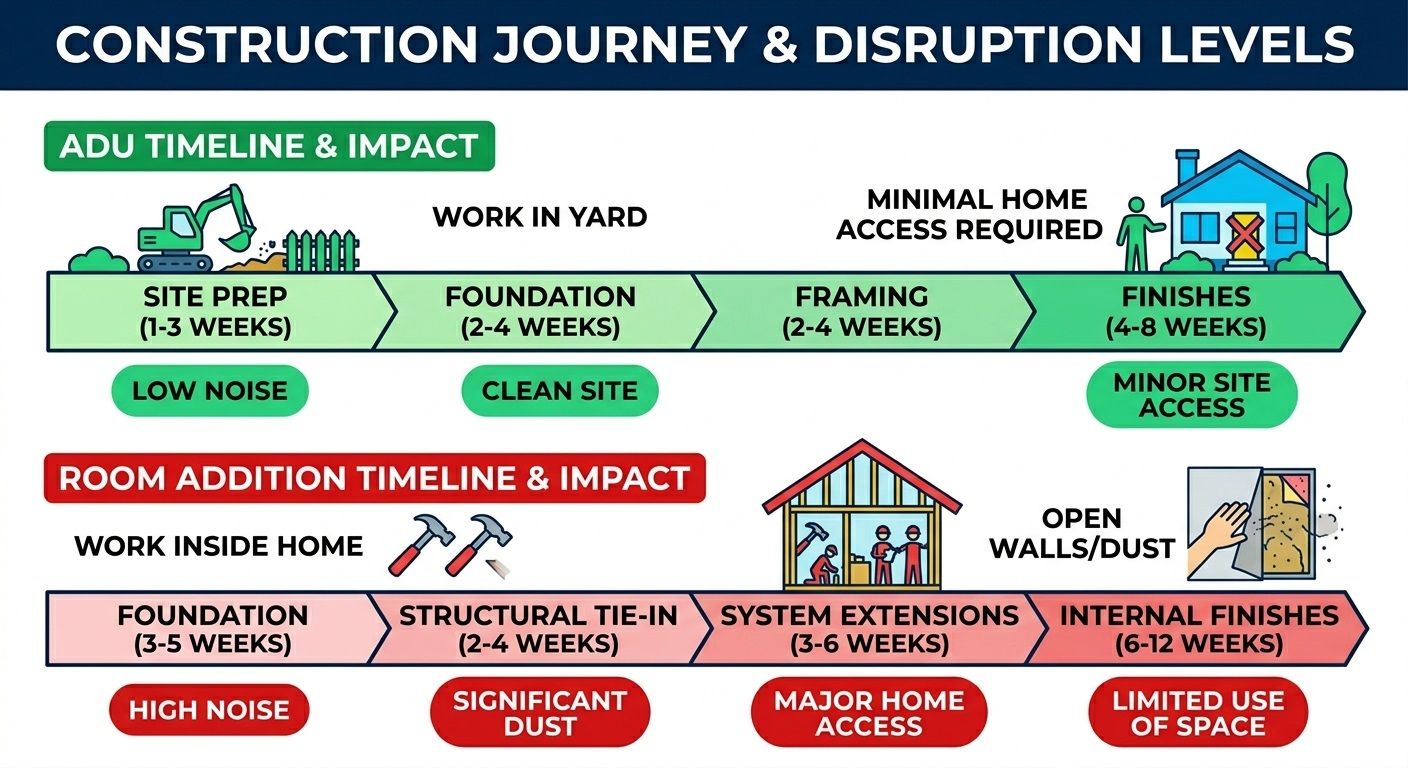
Beyond the construction phases, consider the lived experience: Room additions often involve months of internal disruption, while ADU builds typically occur in the yard.
Project timelines in Los Angeles are shaped by design, permits, inspections, and site conditions—not just build speed. Two projects with similar sizes can move at different speeds depending on complexity and approvals.
ADU Timeline in Los Angeles
ADUs are treated as separate units, which creates a clear, segmented process.
- Design and permitting typically take about 1–3 months, assuming plans are complete and align with ADU rules.
- Construction for many ADUs takes roughly 3–6 months, especially when the structure is detached, site access is straightforward, and utility connections are well planned.
- Garage conversions can move faster because the shell exists; ground‑up ADUs take longer due to full construction.
For a more granular step‑by‑step view of this, the dedicated ADU construction timeline article breaks down phases from design through final inspection.
Room Addition Timeline in Los Angeles
Room additions are tied directly to your existing structure, which changes the rhythm of the project.
- Design and permitting can also take about 1–3 months, but approvals may stretch longer if structural changes are complex, especially for second stories.
- Construction frequently takes 4–9 months, and larger projects—like second‑story additions—can extend beyond that due to sequencing, inspections, and structural work.
For a broader context on renovating a whole home (rather than just adding one room), the post on how long it takes to renovate a house gives more timeline benchmarks.
What Actually Delays Projects in Los Angeles
Delays rarely come from a single cause; they usually stem from a combination of:
- Plan revisions during permitting
- Inspection scheduling delays
- Utility coordination (especially for new meters or upgraded service)
- Structural adjustments discovered once walls or foundations are opened
These issues affect both ADUs and room additions, but additions tend to be more sensitive because they rely so heavily on the existing structure.
ADU vs Room Addition Permit Process in Los Angeles
Before construction begins, both ADUs and room additions must go through the City of Los Angeles approval process. This step often determines how quickly a project can move forward.
How ADU Permits Work in Los Angeles
ADUs benefit from California‑wide housing policies designed to increase residential density, which HCD enforces and LA adopts through local ordinances. The State’s ADU handbook is an excellent high‑level reference, and LADBS’ ADU portal provides the local details, standard plans, and forms.
The process typically includes:
- Submitting architectural plans showing layout, size, setbacks, and utility connections
- Plan review for compliance with state and local ADU rules
- A 60‑day review requirement for most ADU applications under recent updates
- Inspections at key milestones (foundation, framing, finals)
Delays usually occur when plans don’t meet size or setback requirements, utility connections are unclear, or revisions are requested during plan check. Even so, ADUs today are generally easier to approve than in the past thanks to statewide policy support, online submissions, and pre‑approved plan options.
If you want to understand local nuances—including new rules and recent law changes—pair this with the update on the California new ADU law 2024 and the overview of ADU size limits in Los Angeles.
How Room Addition Permits Work in Los Angeles
Room additions follow a more traditional path tightly tied to the existing structure.
The city reviews:
- Architectural plans and structural calculations
- Foundation capacity and load distribution
- Zoning compliance (FAR, height, setbacks)
- Energy, fire, and seismic requirements
Approvals can take longer if structural modifications are extensive, a second story is involved, or zoning limits are being pushed. Inspections also tend to be more layered, evaluating both the new work and how it ties into the existing building.
If you’re considering a broader remodel instead of, or in addition to, an addition, the guide on remodel vs renovation clarifies the terminology and scope differences you’ll see in permit discussions.
Final Verdict: Should You Build an ADU or a Room Addition?
At the surface level, both options solve a lack‑of‑space problem—but in Los Angeles they lead to very different outcomes once the project is complete.
- An ADU creates a second, independent living unit that adds flexibility and opens the door to rental income, private living space, or long‑term adaptability as your needs change.
- A room addition expands and upgrades your existing home, improving layout and daily usability without introducing a separate unit.
Viewed through use rather than just cost:
- If you want income potential, privacy, or a separate living space, an ADU is usually the better fit.
- If you want more space within your current home, a room addition typically makes more sense.
If you’re still exploring other structures and property configurations, the article on SB 9 in Los Angeles is a good resource for understanding how a lot splits and duplexing compared to a single ADU or addition strategy.
Choosing the Right Builder in Los Angeles
The biggest difference between a smooth project and a frustrating one usually comes down to planning and execution. Every property in Los Angeles has its own constraints—lot size, zoning, hillside conditions, seismic considerations, and existing layout—so what works brilliantly for one home may not work for another.
That’s why the first step isn’t simply picking “ADU” or “room addition.” It’s understanding what your property actually allows, what your budget can support, and how you want the space to perform long‑term.
LUX Construction Group works with homeowners across Los Angeles on both ADUs and room additions, helping map out realistic options based on your lot, budget, and goals. Instead of pushing a single solution, the focus is on evaluating feasibility, identifying the most efficient path forward, and aligning your project with how you’ll actually use the space.
Next step:
Schedule a consultation to review your property and get a tailored ADU vs room‑addition plan for your Los Angeles home.
ADU vs Room Addition FAQs
Do I need extra parking for an ADU in Los Angeles?
In many LA locations, no new parking is required for an ADU if you’re near transit or converting an existing garage, but site‑specific ADU parking rules still apply, so always confirm with local zoning or LADBS.
How does an ADU affect my homeowners insurance?
An ADU can change your dwelling, personal‑property, and liability coverage needs; you may need higher limits or an endorsement to ensure the new structure and any rental activity are fully insured.
What fire‑safety requirements apply to ADUs in high‑risk LA areas?
In California fire‑hazard zones, ADUs may need fire‑rated materials, defensible space, and stricter setbacks, following California Fire Code and local high‑fire‑zone regulations.
Are there ADU occupancy or owner‑residency rules in Los Angeles?
Current California rules generally waive owner‑occupancy for many ADUs through at least the mid‑2020s, allowing you to rent both the main home and the ADU, subject to local ordinances.