Last Updated on March 18, 2026
Walls fail more often because of material choice than poor workmanship. A retaining wall that uses the wrong block type can crack within a few seasons. A partition wall built with structural blocks can unnecessarily increase project costs. Builders, architects, and contractors often face this decision early in a project: which concrete block type fits the structural requirement, insulation needs, and load conditions of the structure?
Concrete blocks—commonly called Concrete Masonry Units (CMUs) in construction engineering—are widely used because they provide structural strength, fire resistance, and relatively predictable performance in load-bearing systems. According to the National Concrete Masonry Association (NCMA), concrete masonry is used in a large share of low-rise commercial and residential buildings due to its durability and structural stability.
Understanding the different types of concrete blocks and their structural applications helps builders choose materials that match the strength, durability, and insulation requirements of a project.
In the sections below, we explain the major concrete block types used in construction, their properties, and where each type is commonly used.
Contents
- What Are Concrete Masonry Units (CMU)?
- Main Categories of Concrete Blocks Used in Construction
- Types of Hollow Concrete Blocks Used in Masonry Construction
- Types of Solid Concrete Blocks Used in Structural Construction
- Standard Concrete Block Sizes and Dimensions (CMU Sizes)
- Compressive Strength of Concrete Blocks
- Hollow vs Solid Concrete Blocks: Structural Differences
- How to Choose the Right Concrete Block for Construction
- Common Applications of Concrete Blocks in Construction
- When Should You Work With a Construction Specialist?
- Concrete Blocks FAQs
What Are Concrete Masonry Units (CMU)?
Concrete Masonry Units (CMU) are standardized building blocks made from Portland cement, aggregates, and water. These materials are molded and cured to form durable masonry units used in structural and non-structural walls.
Compared with traditional bricks, CMUs are larger and modular, which reduces the number of joints in a wall system. Fewer joints improve:
- construction speed
- structural alignment
- mortar efficiency
Materials Used to Produce Concrete Blocks
Concrete blocks typically contain:
- Portland cement – provides bonding strength
- Aggregates – sand, gravel, or crushed stone that create density and durability
- Water – activates the cement hydration process
- Supplementary materials – such as fly ash, which can improve sustainability and reduce cement consumption
According to environmental research referenced by the U.S. Environmental Protection Agency, reusing fly ash in construction materials helps reduce landfill waste and lowers the environmental impact associated with cement production.
Concrete Block Manufacturing Process
Concrete blocks are produced through a controlled industrial process to ensure uniform strength and dimensions.
Typical production steps include:
- Mixing cement, aggregates, and water
- Pouring the mixture into steel molds
- Compacting the material using vibration and compression
- Curing the blocks in controlled environments
- Testing finished units for compressive strength and dimensional accuracy
Load-bearing CMUs must meet standards such as ASTM C90, which defines minimum compressive strength requirements for structural masonry blocks.
Main Categories of Concrete Blocks Used in Construction
Concrete blocks are commonly grouped according to internal structure, density, and structural function. Most blocks fall into three main categories:
- Hollow concrete blocks
- Solid concrete blocks
- Lightweight concrete blocks
Each category provides different levels of strength, insulation, and structural weight.
1. Hollow Concrete Block Types in Masonry Construction
Hollow blocks contain internal cavities that reduce weight and allow reinforcement with steel bars and grout.
Key characteristics:
- lighter than solid blocks
- easier to transport and install
- compatible with reinforced masonry systems
- moderate insulation due to internal air cavities
Common uses include:
- residential exterior walls
- reinforced masonry structures
- partition walls
2. Solid Concrete Blocks for Structural Construction
Solid concrete blocks contain little or no internal cavities, making them denser and stronger.
Key characteristics:
- higher compressive strength
- strong resistance to weather and impact
- suitable for structural load-bearing applications
Common uses include:
- foundation walls
- retaining structures
- structural columns
3. Lightweight Concrete Blocks for Insulated Walls
Lightweight blocks use aerated mixtures or lightweight aggregates to reduce density.
Examples include:
- Autoclaved Aerated Concrete (AAC)
- cellular lightweight concrete blocks
- expanded clay aggregate blocks
Advantages include:
- reduced structural load
- improved insulation performance
- easier installation
Types of Hollow Concrete Blocks Used in Masonry Construction
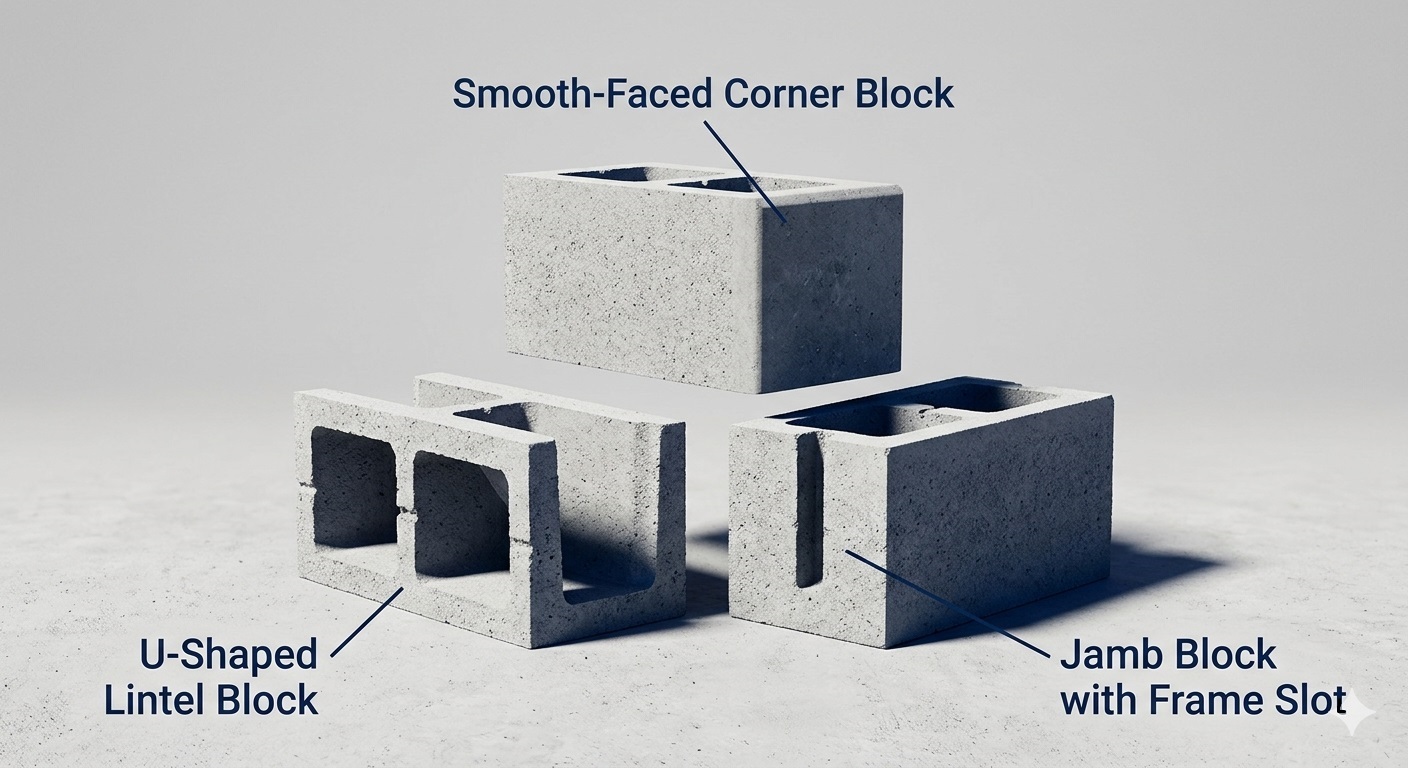
Specialized block profiles allow for seamless integration of doors, windows, and reinforced corners.
Hollow blocks form the primary structure of many masonry walls. Different shapes allow builders to create reinforced walls, structural corners, and openings.
1. Stretcher Concrete Blocks
Most commonly used masonry units. Installed with the long side parallel to the wall surface.
Used for:
- load-bearing walls
- exterior masonry walls
- reinforced wall systems
2. Corner Concrete Blocks
Designed to create strong wall intersections and edges.
Used for:
- building corners
- structural wall junctions
3. Jamb Concrete Blocks for Door and Window Frames
Specialized blocks used around doors and window openings.
Functions:
- secure window frames
- support door frames
- allow reinforcement around openings
4. Lintel Concrete Blocks for Structural Openings
Contain a U-shaped channel for reinforcement and concrete.
Used to form reinforced beams above openings such as:
- doors
- windows
5. Column Concrete Blocks for Masonry Pillars
Square units designed to form reinforced masonry columns when stacked and grouted.
Used for:
- structural pillars
- fence posts
- masonry piers
6. Bullnose Concrete Blocks for Rounded Corners
Blocks with rounded edges used for exposed corners where a smoother finish is needed.
Common in:
- architectural corners
- garden walls
7. Partition Concrete Blocks for Interior Walls
Thinner blocks used for interior non-load-bearing walls.
Advantages:
- reduced weight
- space for wiring or plumbing
8. Split-Face Concrete Blocks for Decorative Masonry
Manufactured with a textured surface by splitting the block to expose aggregates.
Commonly used for:
- decorative facades
- commercial exterior walls
Types of Solid Concrete Blocks Used in Structural Construction
Solid masonry units provide greater density and compressive strength for structural applications.
1. Autoclaved Aerated Concrete (AAC) Blocks
AAC blocks are produced using cement, lime, sand, water, and aluminum powder, creating microscopic air pockets during manufacturing.
Key features:
- lightweight structure
- high insulation performance
- easy cutting and shaping
Often used in:
- residential exterior walls
- energy-efficient buildings
2. Cellular Lightweight Concrete Blocks
Made by mixing cement with pre-formed foam, creating air cells throughout the block.
Advantages:
- lightweight
- good sound insulation
- fire resistance
Typical uses:
- partition walls
- parapet walls
3. Expanded Clay Aggregate Concrete Blocks
Produced using kiln-fired clay aggregates mixed with cement.
Benefits:
- reduced structural weight
- improved thermal insulation
- moisture resistance
4. Fly Ash Concrete Blocks
Manufactured from fly ash, cement, and sand.
Advantages:
- improved durability
- reduced cracking
- reuse of industrial byproducts
5. Concrete Paving Blocks for Roads and Walkways
Dense solid units designed for surface loads rather than wall construction.
Used for:
- driveways
- sidewalks
- parking areas
- landscape paths
Standard Concrete Block Sizes and Dimensions (CMU Sizes)
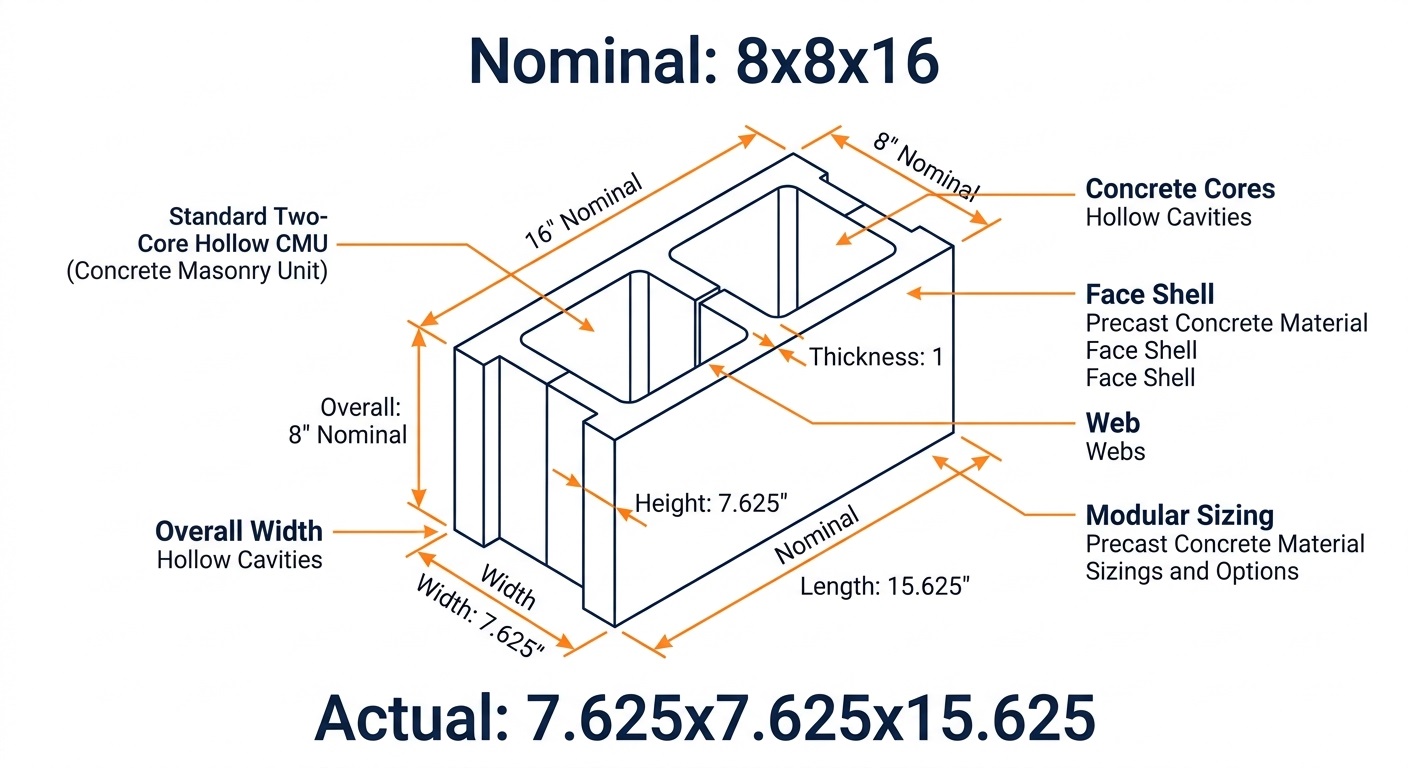
Precise modular dimensions ensure consistent mortar joints and efficient wall alignment.
Concrete blocks follow standardized modular dimensions, allowing consistent mortar joints and efficient wall construction.
Nominal vs Actual Block Dimensions
| Nominal Size | Actual Size | Typical Use |
| 4 × 8 × 16 in | 3.625 × 7.625 × 15.625 | partition walls |
| 6 × 8 × 16 in | 5.625 × 7.625 × 15.625 | light walls |
| 8 × 8 × 16 in | 7.625 × 7.625 × 15.625 | load-bearing walls |
| 12 × 8 × 16 in | 11.625 × 7.625 × 15.625 | foundation walls |
The 8 × 8 × 16 block is the most commonly used CMU in masonry construction.
Block Thickness and Structural Use
| Thickness | Application |
| 4 inches | interior partitions |
| 6 inches | light structural walls |
| 8 inches | exterior load-bearing walls |
| 10–12 inches | foundations and retaining walls |
Standard sizing improves construction speed and structural consistency.
Compressive Strength of Concrete Blocks
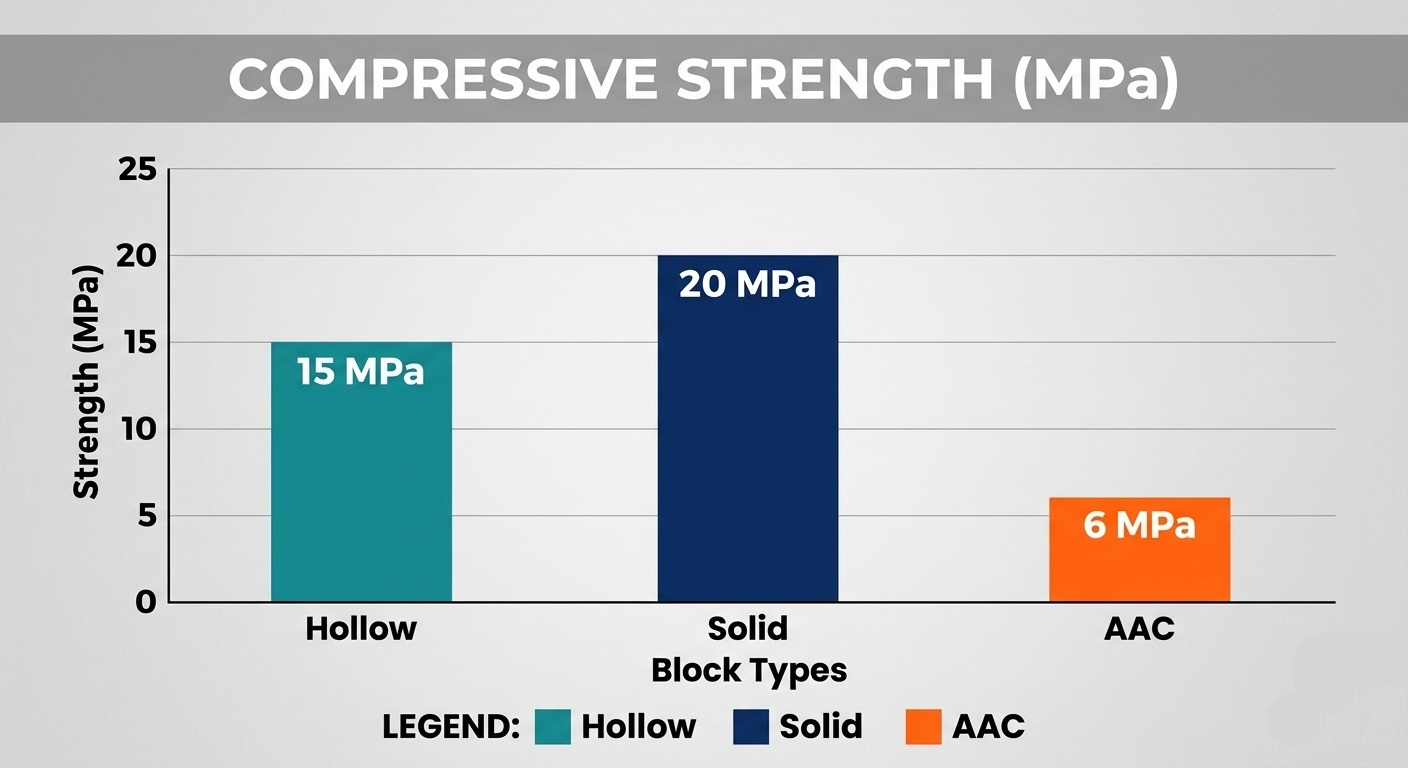
Solid blocks offer the highest load-bearing capacity, making them ideal for foundations and columns.
Compressive strength measures the maximum load a block can withstand before failure. Load-bearing CMUs must meet standards such as ASTM C90.
Typical Strength Ranges
| Block Type | Strength |
| Hollow concrete blocks | 3.5–15 MPa |
| Solid concrete blocks | 7–20 MPa |
| AAC blocks | 3–6 MPa |
Factors That Affect Block Strength
- cement content
- aggregate quality
- molding compaction
- curing conditions
These factors determine whether blocks can be used for load-bearing or non-load-bearing walls.
Hollow vs Solid Concrete Blocks: Structural Differences
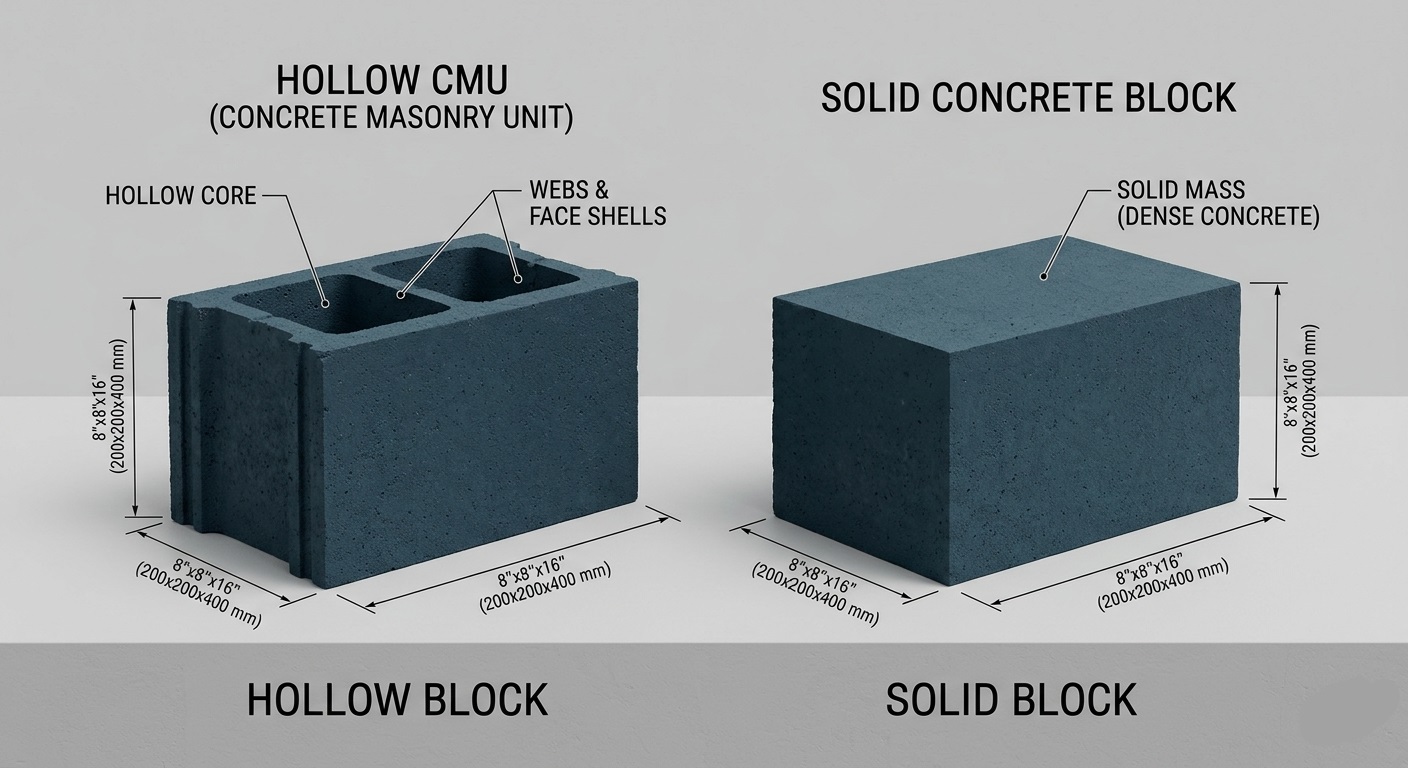
Precise modular dimensions ensure consistent mortar joints and efficient wall alignment.
Concrete blocks used in masonry construction are primarily classified as hollow or solid based on their internal structure. This structural difference influences weight, compressive strength, insulation performance, and installation methods.
Key Differences Between Hollow and Solid Concrete Blocks
| Feature | Hollow Concrete Blocks | Solid Concrete Blocks |
| Internal structure | Contain cavities or hollow cores | Dense structure with minimal or no cavities |
| Weight | Lighter due to internal voids | Heavier because of solid composition |
| Compressive strength | Moderate (typically 3.5–15 MPa) | Higher strength (typically 7–20 MPa) |
| Reinforcement capability | Cavities allow steel bars and grout reinforcement | Limited reinforcement options |
| Thermal insulation | Better insulation because air cavities reduce heat transfer | Lower insulation due to dense structure |
| Ease of installation | Easier to handle and transport | Requires more effort due to higher weight |
| Typical applications | residential walls, reinforced masonry, partition walls | foundations, retaining walls, structural supports |
| Construction cost | usually lower due to reduced material weight | slightly higher material and labor cost |
Both block types are used in modern masonry construction. Hollow blocks are often selected for wall systems where reinforcement and reduced structural weight are important, while solid blocks are preferred in areas requiring higher compressive strength and durability.
Understanding these differences helps builders determine which block type best matches the structural requirements of a project.
How to Choose the Right Concrete Block for Construction
Selecting the correct block depends on structural load, insulation needs, and project type.
-
Structural Load:
Structural walls require denser blocks with higher compressive strength.
| Construction Use | Recommended Block |
| Load-bearing walls | reinforced hollow or solid blocks |
| structural columns | column blocks with reinforcement |
| partition walls | hollow or lightweight blocks |
-
Thermal insulation:
AAC or hollow blocks perform better in temperature-sensitive environments.
| Block Type | Insulation Level |
| AAC blocks | high |
| hollow blocks | moderate |
| solid blocks | lower |
-
Weight considerations:
Lightweight blocks reduce the structural load on foundations.
| Block Type | Weight |
| AAC blocks | very light |
| hollow blocks | moderate |
| solid blocks | heavy |
-
Construction speed:
Large hollow blocks accelerate wall construction compared with traditional brick masonry.
Builders typically consult structural engineers or construction contractors before choosing block types to ensure the building complies with structural and safety standards.
Common Applications of Concrete Blocks in Construction
Concrete blocks are widely used because they combine strength, durability, and fire resistance.
- Load-Bearing Walls: Reinforced CMU walls support roof and floor loads in residential and commercial buildings.
- Foundations: Solid blocks or reinforced hollow blocks are used in basement walls and crawlspace foundations.
- Retaining Walls: Dense masonry blocks resist soil pressure and moisture exposure.
- Partition Walls: Hollow or lightweight blocks create interior room divisions without adding structural load.
- Paving and Landscaping : Concrete paving blocks support foot traffic and vehicle loads in outdoor areas.
When Should You Work With a Construction Specialist?
Material selection is only one part of a successful building project. Structural load calculations, reinforcement planning, and local building regulations also influence how masonry systems are built.
If you are planning residential or commercial construction in Los Angeles, working with experienced contractors can help prevent costly structural mistakes.
LUX Construction Group provides design-build services for projects such as:
Contact us to get started!
Concrete Blocks FAQs
What is the difference between a cinder block and a concrete block?
Concrete blocks contain cement and aggregates. Cinder blocks contain coal cinders as aggregate. Concrete blocks provide higher compressive strength and durability, while cinder blocks are typically used in lighter masonry applications.
How long do concrete block walls last?
Concrete block walls typically last 50–100 years when properly constructed and maintained. Concrete masonry resists fire, pests, and moisture, which contributes to long structural durability.
Are concrete blocks environmentally sustainable?
Concrete blocks can support sustainable construction. Fly ash blocks reuse industrial byproducts, reducing cement consumption and lowering carbon emissions associated with cement production.
Can concrete blocks be reinforced with steel?
Concrete masonry units allow steel reinforcement bars and grout filling inside hollow cores. Reinforced masonry walls improve structural strength and stability.
What mortar is used for concrete block walls?
Concrete block masonry commonly uses Type S mortar for structural walls and Type N mortar for general residential masonry construction.