
Last Updated on May 4, 2026
Choosing a commercial construction type is not just a naming exercise. The type of project determines how the space is planned, which permits may apply, what building systems need attention, and what kind of contractor experience matters.
A restaurant buildout, medical office, warehouse, retail store, and office renovation can all fall under commercial construction, but they do not follow the same construction path. A restaurant may need kitchen exhaust, grease systems, fire suppression, and health department review. A medical office may need patient-flow planning, accessibility upgrades, equipment clearance, and specialized electrical or plumbing coordination. A warehouse may depend more on clear height, loading access, racking layout, fire protection, and material movement.
In simple terms, commercial construction refers to building, remodeling, or improving spaces used for business, public service, industrial work, healthcare, hospitality, retail, or income-producing purposes.
In 2018, the U.S. had about 5.9 million commercial buildings with roughly 96.4 billion square feet of floorspace, according to the U.S. Energy Information Administration. That scale is one reason commercial construction is usually grouped by building use, project type, construction method, and project size. [source]
For business owners planning commercial construction in Los Angeles, the real question is not only what type of building they need. It is whether the space will be used for customers, patients, tenants, employees, storage, manufacturing, food service, or mixed uses. That answer affects layout, utilities, accessibility, inspections, and long-term operating needs.
This guide breaks down the 13 main types of commercial construction and explains what makes each one different from a planning, systems, compliance, and contractor-selection perspective.
Contents
- How Commercial Construction Types Are Categorized
- 13 Main Types of Commercial Construction
- Which Types of Commercial Construction Require the Most Planning?
- Common Building Methods Used in Commercial Construction
- Commercial Construction by Project Scale
- What Los Angeles Owners Should Check Before Commercial Construction
- How to Choose a Commercial Contractor by Project Type
- FAQs About Commercial Construction Types
- Plan Your Commercial Construction Project With Lux Construction Group
How Commercial Construction Types Are Categorized
Commercial construction is usually categorized in more than one way. A project can be classified by building use, type of work, construction method, and project scale.
The most useful classification for owners is building use, because it affects the construction scope immediately. A restaurant, clinic, office, warehouse, and hotel each require different layouts, utilities, inspections, and contractor coordination.
# Commercial Construction by Building Use
Common commercial construction sectors include retail, office, restaurant, healthcare, hospitality, industrial, warehouse, mixed-use, multifamily, institutional, and specialty commercial spaces.
A retail store is planned around customer movement and product visibility. A medical office is planned around patients, equipment, privacy, sanitation, and accessibility. A warehouse is planned around storage, loading, racking, fire protection, and material flow.
# Commercial Construction by Project Type
Commercial construction can also be grouped by the type of work being performed. Common project types include new commercial construction, tenant improvement, commercial buildout, remodeling, and renovation.
A new building starts from the ground up. A tenant improvement project turns a leased space into a usable business location. A renovation updates or reworks an existing commercial space, often to improve layout, code compliance, accessibility, or operations.
# Commercial Construction by Building Method
Some commercial buildings are classified by the structural method used, such as steel frame, concrete tilt-up, pre-engineered metal buildings, or modular construction.
This classification matters more during design and estimating than during early business planning. For most owners, the project’s use comes first; the construction method is selected later based on budget, site conditions, building size, engineering needs, and schedule.
# Commercial Construction by Project Scale
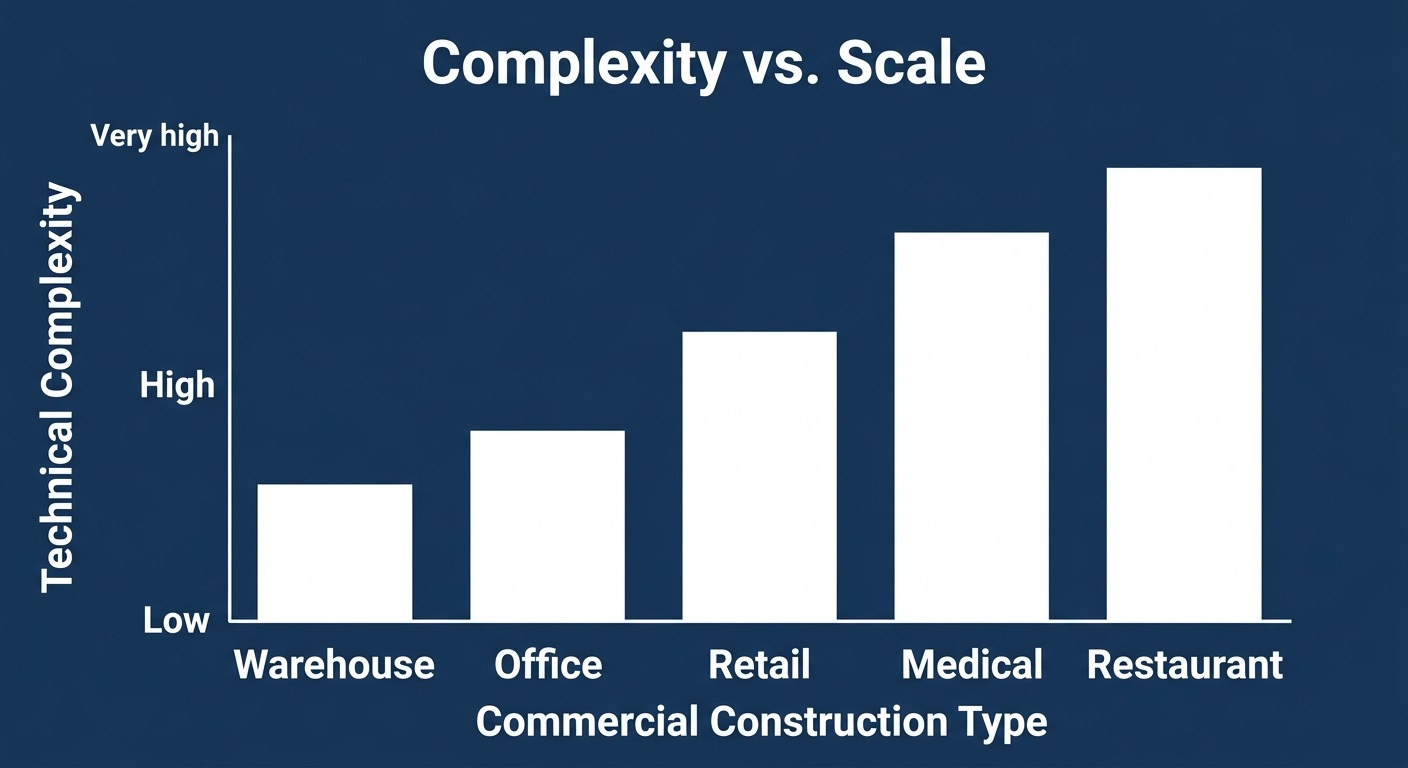
Why size isn’t the only factor: specialized systems drive project complexity.
Commercial projects may also be small-scale, medium-scale, or large-scale.
A small-scale project may involve a café buildout, office suite renovation, or retail tenant improvement. A medium-scale project may include a medical clinic, restaurant, multi-tenant retail space, or small warehouse. A large-scale project may involve a hotel, mixed-use building, distribution center, or industrial facility.
Size matters, but scale alone does not define complexity. A small restaurant can be more complicated than a larger office suite because of kitchen systems, fire suppression, ventilation, plumbing, and health department review.
13 Main Types of Commercial Construction
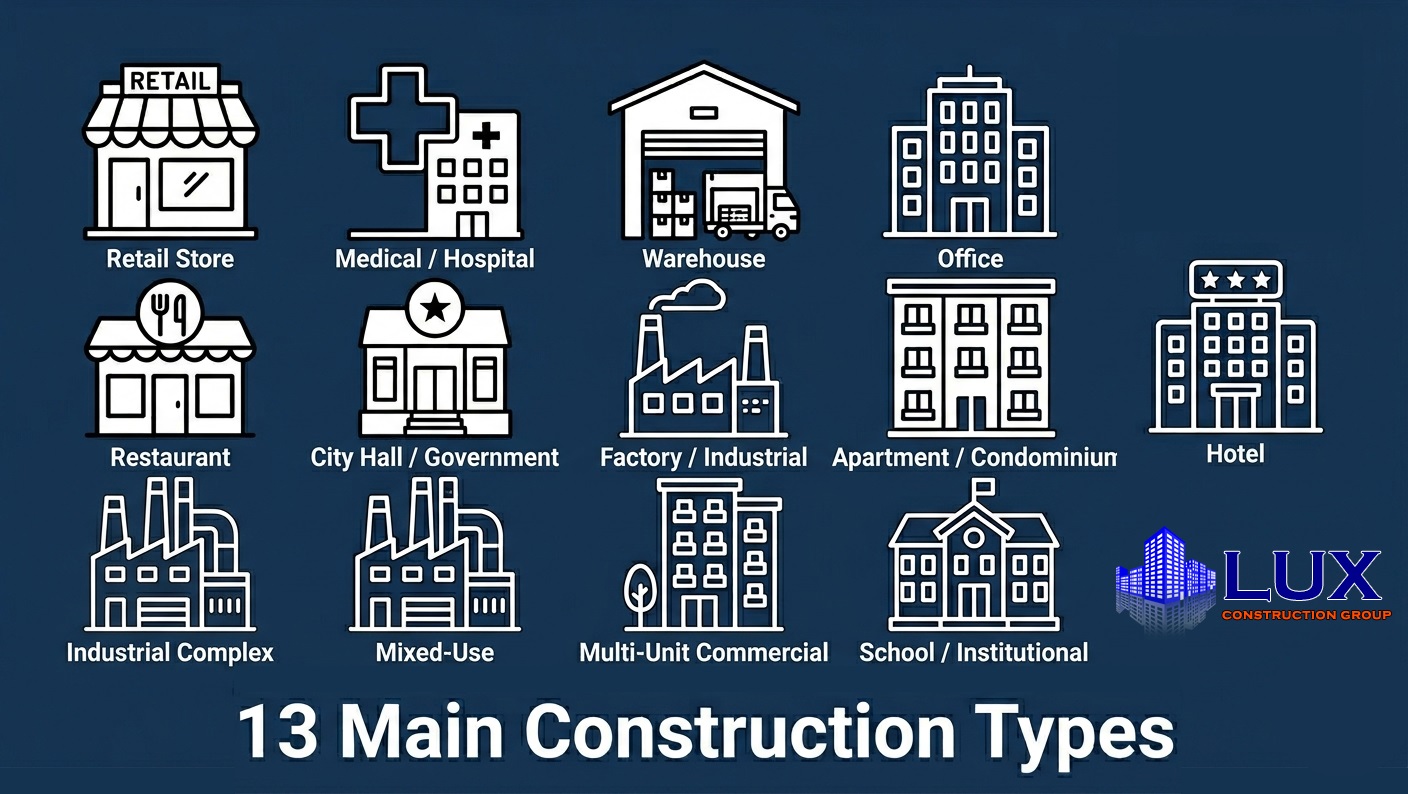
Use-based classification is the most critical starting point for any owner.
Commercial construction types are best understood by the purpose of the building and the work needed to make the space operational. The same square footage can require very different planning depending on whether it will serve customers, patients, tenants, employees, guests, inventory, equipment, or production.
1. Retail Construction
Retail construction includes stores, boutiques, showrooms, shopping plazas, convenience stores, and other customer-facing sales spaces.
The main construction goal is to create a space that supports buying behavior. The layout must help customers enter easily, move through the store, view products clearly, reach checkout without friction, and exit safely.
Retail projects often require planning around storefront visibility, signage, lighting, product displays, checkout counters, storage areas, ADA access, restrooms, and security systems. In franchise retail, the contractor may also need to follow brand standards while adapting the design to local building codes and site conditions.
A retail buildout is usually less system-heavy than a restaurant or medical office, but it still needs careful coordination. Poor lighting, narrow circulation paths, weak storefront design, or noncompliant access can hurt both customer experience and inspections.
2. Restaurant Construction
Restaurant construction includes full-service restaurants, cafes, bars, quick-service restaurants, commercial kitchens, and food-service tenant improvements.
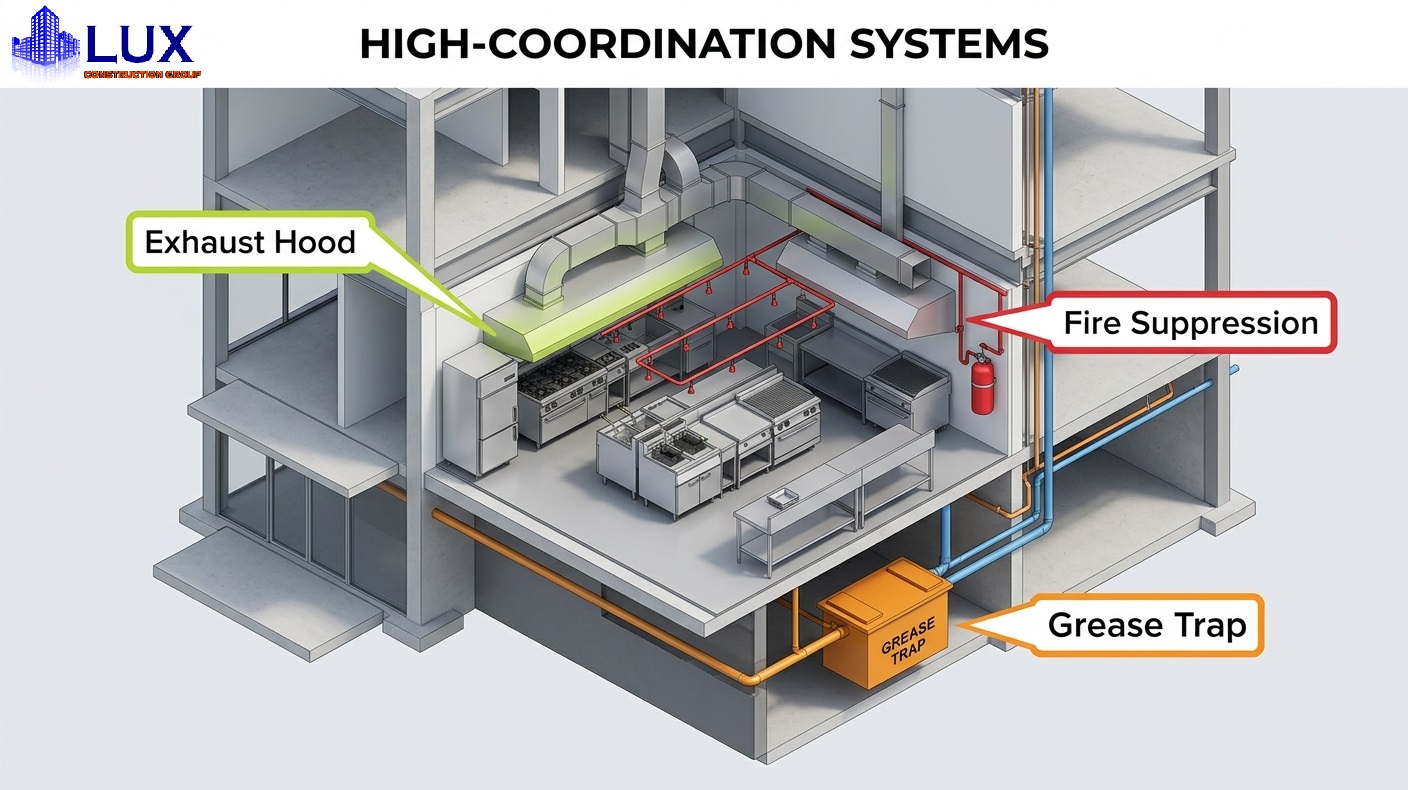
Restaurants require heavy coordination of plumbing, mechanical, and fire-safety systems.
This is one of the most coordination-heavy commercial construction types because the dining area is only one part of the project. The kitchen, plumbing, electrical systems, ventilation, fire suppression, grease management, restrooms, storage, and health department requirements all affect the final layout.
Restaurant owners usually need to plan for kitchen workflow, exhaust hoods, grease interceptors, gas lines, walk-in coolers, floor drains, fire-rated materials, ADA-compliant restrooms, staff circulation, and customer seating capacity. A mistake in one system can delay opening even if the visible dining area looks finished.
For restaurant remodeling in Los Angeles, local review can also involve health department requirements, fire/life-safety checks, accessibility compliance, and building inspections.
3. Office Construction
Office construction includes professional suites, corporate offices, coworking spaces, administrative offices, and tenant office buildouts.
Most office projects are driven by workflow. The layout needs to support focused work, meetings, collaboration, privacy, storage, technology, and employee movement. A finished office is not just a set of rooms; it is a working environment that depends on lighting, acoustics, HVAC comfort, data access, and circulation.
Common office construction needs include private offices, open work areas, conference rooms, break rooms, reception areas, restrooms, lighting upgrades, HVAC zoning, sound control, low-voltage cabling, flooring, and interior partitions.
Office projects often fall under tenant improvement construction because businesses frequently lease an unfinished or outdated suite and adapt it to their operations. An office renovation checklist can help identify layout, utility, finish, and compliance needs before work starts.
4. Medical and Healthcare Construction
Medical and healthcare construction includes clinics, dental offices, urgent care centers, diagnostic spaces, imaging rooms, physical therapy centers, and medical office suites.
Healthcare spaces require stricter planning than standard office interiors because the building must support patients, staff, equipment, privacy, sanitation, accessibility, and inspections. Layout mistakes can affect patient flow, treatment efficiency, safety, and compliance.
Medical projects often involve specialized plumbing, higher electrical demand, HVAC zoning, equipment clearances, accessible exam rooms, sterilization areas, patient waiting areas, staff work zones, medical storage, and privacy-focused layouts. Imaging rooms or diagnostic areas may require additional planning around shielding, equipment placement, and room clearance.
For specialized healthcare spaces, owners may need a contractor experienced in dental and medical office construction, urgent care facility buildouts, or radiology room design and construction.
5. Industrial Construction
Industrial construction includes manufacturing facilities, production spaces, workshops, assembly areas, processing buildings, and light industrial facilities.
The planning starts with operations. Before finishes, offices, or exterior appearance, the project needs to account for machinery, equipment access, production flow, safety zones, ventilation, floor loading, electrical capacity, and material movement.
Industrial buildings often require durable surfaces, wider circulation paths, overhead doors, service areas, equipment foundations, specialized exhaust, and clear separation between work zones. The contractor must understand how people, materials, machines, and finished products move through the building.
6. Warehouse and Distribution Construction
Warehouse and distribution construction includes storage buildings, logistics facilities, fulfillment centers, distribution hubs, and loading-focused commercial spaces.
These projects are built around movement and storage density. The layout must support how goods arrive, get unloaded, stored, picked, packed, staged, and shipped. That makes clear height, loading docks, truck access, racking systems, forklift circulation, lighting, fire protection, and material-handling routes critical.
Warehouse projects may look simple from the outside, but small planning mistakes can reduce usable storage, slow loading operations, or create safety issues. Fire-suppression design, aisle spacing, dock placement, and lighting all affect how efficiently the building works.
Owners comparing project feasibility should also review warehouse construction cost factors because racking, clear height, loading systems, fire protection, and site access can change the budget quickly.
7. Hotel and Hospitality Construction
Hotel and hospitality construction includes hotels, boutique lodging, guest rooms, lobbies, corridors, service areas, laundry rooms, dining spaces, and guest amenities.
Hospitality projects combine repeated room layouts with guest experience. A hotel may have dozens or hundreds of similar rooms, but each one still depends on plumbing stacks, sound control, fire-rated corridors, HVAC comfort, privacy, accessibility, and life-safety systems.
The public areas matter just as much. Lobbies, elevators, check-in areas, restrooms, back-of-house corridors, laundry areas, storage, and service routes must work together without disrupting guests. Poor planning can create noise issues, maintenance problems, slow housekeeping routes, or uncomfortable guest movement.
8. Mixed-Use Construction
Mixed-use construction combines two or more uses in one building or development, such as retail below apartments, restaurants beside offices, or residential units above commercial space.
These projects are more complex because different occupants use the same property in different ways. A ground-floor restaurant may need exhaust, grease systems, deliveries, and late operating hours, while residential units above need privacy, sound control, separate access, and fire separation.
Mixed-use projects often require planning around separate entrances, utility separation, fire-rated assemblies, noise control, parking, trash areas, delivery access, accessibility, and different occupancy requirements. This is where the difference between commercial and residential construction becomes practical because one building may include both use types.
9. Multifamily Construction
Multifamily construction includes apartments, condominiums, duplex-style rental properties, townhome communities, and other income-producing residential buildings.
These buildings are residential in use, but they are often treated as commercial real estate because they are built, owned, or managed as investment properties. That changes how owners think about layout efficiency, shared systems, parking, maintenance, accessibility, fire separation, and long-term operating costs.
Multifamily projects usually require planning around unit layouts, corridors, stairs, elevators, utility metering, common areas, trash rooms, laundry areas, mechanical systems, parking access, and sound control between units. The building must work for residents, property managers, maintenance teams, and emergency access.
10. Tenant Improvement Construction
Tenant improvement construction modifies a leased commercial space so a business can operate inside it. It is common in office suites, retail stores, restaurants, clinics, salons, studios, and other tenant-occupied properties.
This type of work often begins after a lease is signed, but before the business can open. The scope may include interior partitions, flooring, lighting, restrooms, HVAC changes, electrical upgrades, data cabling, plumbing, finishes, accessibility improvements, and code corrections.
Tenant improvements require clear coordination between the tenant, landlord, contractor, architect, and property manager. The lease may define what the landlord provides, what the tenant pays for, and which improvements must be approved before construction starts.
A commercial renovation planning checklist can help owners and tenants organize layout changes, utility needs, finish selections, inspection requirements, and opening deadlines before work begins.
11. Commercial Remodeling and Renovation
Commercial remodeling and renovation involve updating an existing business space instead of building a new structure from the ground up.
This can include layout changes, restroom upgrades, ADA improvements, facade updates, flooring replacement, lighting upgrades, mechanical system changes, plumbing improvements, electrical corrections, structural repairs, or adaptive reuse. The goal may be to improve customer experience, support a new business use, meet code requirements, or extend the life of the building.
Renovation projects often carry more uncertainty than new construction because the contractor may uncover outdated wiring, hidden plumbing issues, structural damage, poor ventilation, or noncompliant previous work. These conditions can affect cost, schedule, and inspection requirements.
12. Institutional Construction
Institutional construction includes schools, training centers, nonprofit facilities, religious buildings, community centers, and other spaces used by groups, students, staff, members, or the public.
These projects are usually planned around durability, safety, accessibility, and high daily use. The building may need classrooms, offices, restrooms, gathering areas, kitchens, storage rooms, administrative areas, outdoor access, and circulation paths that can handle large groups.
Institutional projects may also require phased scheduling, especially when construction takes place while the facility remains partially active. That means safety barriers, temporary access routes, noise control, and clear communication become part of the construction plan.
13. Specialty Commercial Construction
Specialty commercial construction covers business spaces with unique operational, equipment, utility, or customer-experience requirements. Examples include gyms, salons, spas, wellness centers, studios, laboratories, entertainment venues, and fitness facilities.
These projects do not always fit neatly into standard office, retail, or restaurant categories. A gym may need reinforced flooring, locker rooms, showers, ventilation, and acoustic control. A salon may need plumbing for wash stations, strong lighting, ventilation, electrical planning, and customer flow. A studio may depend on sound control, lighting, equipment placement, and flexible open space.
Specialty spaces should be planned around the business model first. The contractor needs to understand what happens inside the space, what equipment is used, how customers move, where staff work, and which systems must support daily operations.
Which Types of Commercial Construction Require the Most Planning?
Some commercial projects are harder to coordinate because several systems must work together before the space can open. The most complex types are usually the ones where layout, utilities, code compliance, equipment, and daily operations are tightly connected.
| Commercial Construction Type | Why It Requires More Coordination |
| Restaurant construction | Kitchen workflow, exhaust, grease systems, plumbing, fire suppression, ADA restrooms, and health department review must align before opening. |
| Medical and healthcare construction | Patient flow, sanitation, accessibility, equipment clearance, electrical capacity, privacy, and inspections affect how the space can operate. |
| Mixed-use construction | Different occupancies may require separate entrances, utilities, fire separation, sound control, parking, and access planning. |
| Industrial construction | Machinery placement, floor loading, ventilation, electrical demand, safety zones, and production flow must be planned together. |
| Warehouse and distribution construction | Loading docks, racking, truck access, fire protection, lighting, forklift circulation, and storage layout affect operational efficiency. |
| Hotel and hospitality construction | Guest rooms, plumbing stacks, acoustic control, corridors, elevators, service areas, and life-safety systems must support both comfort and operations. |
A simple rule works for most owners: the more a project depends on specialized systems, inspections, equipment, or occupancy separation, the earlier the contractor, architect, and engineers should be involved.
Common Building Methods Used in Commercial Construction
Commercial construction can also be classified by the structural method used to build the property. This matters during design, estimating, engineering, and scheduling, but for most owners it comes after the building use is clear.
| Construction Method | Common Commercial Uses | What Owners Should Know |
| Steel frame construction | Offices, warehouses, industrial buildings, multi-story commercial spaces | Useful for larger spans, flexible layouts, and durable structures. Engineering, fire protection, and budget planning are important early. |
| Concrete tilt-up or reinforced concrete | Warehouses, retail buildings, industrial facilities, commercial shells | Often used for durable commercial buildings with large wall panels or strong structural demands. Site access and panel handling can affect scheduling. |
| Pre-engineered metal buildings | Warehouses, storage buildings, workshops, light industrial spaces | Can be efficient for simple commercial forms, but customization, insulation, code requirements, and exterior appearance still need planning. |
| Modular or prefabricated construction | Offices, healthcare spaces, hospitality units, temporary or repeatable commercial spaces | Built partly off-site, then assembled on-site. It may reduce field time, but transport, approvals, customization, and site preparation can limit its use. |
The construction method should support the business use, not the other way around. A warehouse, restaurant, medical office, and hotel may all need different structural and system decisions because their operations are different.
Commercial Construction by Project Scale
Commercial projects are often described as small-scale, medium-scale, or large-scale. Size matters, but it does not tell the full story.
| Project Scale | Common Examples | What Changes During Construction |
| Small-scale commercial construction | Small offices, cafes, retail shops, salons, tenant improvements | Shorter schedules, smaller teams, and limited site logistics, but permits, ADA access, inspections, and utility updates may still apply. |
| Medium-scale commercial construction | Restaurants, clinics, multi-tenant retail spaces, small warehouses, larger office buildouts | More coordination between trades, architects, engineers, inspectors, landlords, and business owners. |
| Large-scale commercial construction | Hotels, mixed-use buildings, distribution centers, industrial facilities, large warehouses | More engineering, site logistics, phased scheduling, safety planning, subcontractor coordination, and budget control. |
Project scale should be evaluated with project complexity. Square footage matters, but the real workload comes from the systems, approvals, occupancy requirements, and business operations the building must support.
What Los Angeles Owners Should Check Before Commercial Construction
Commercial construction in Los Angeles can involve more than design, labor, and materials. The property’s use, location, age, and existing condition can affect what approvals, upgrades, and inspections are needed before the space can open.
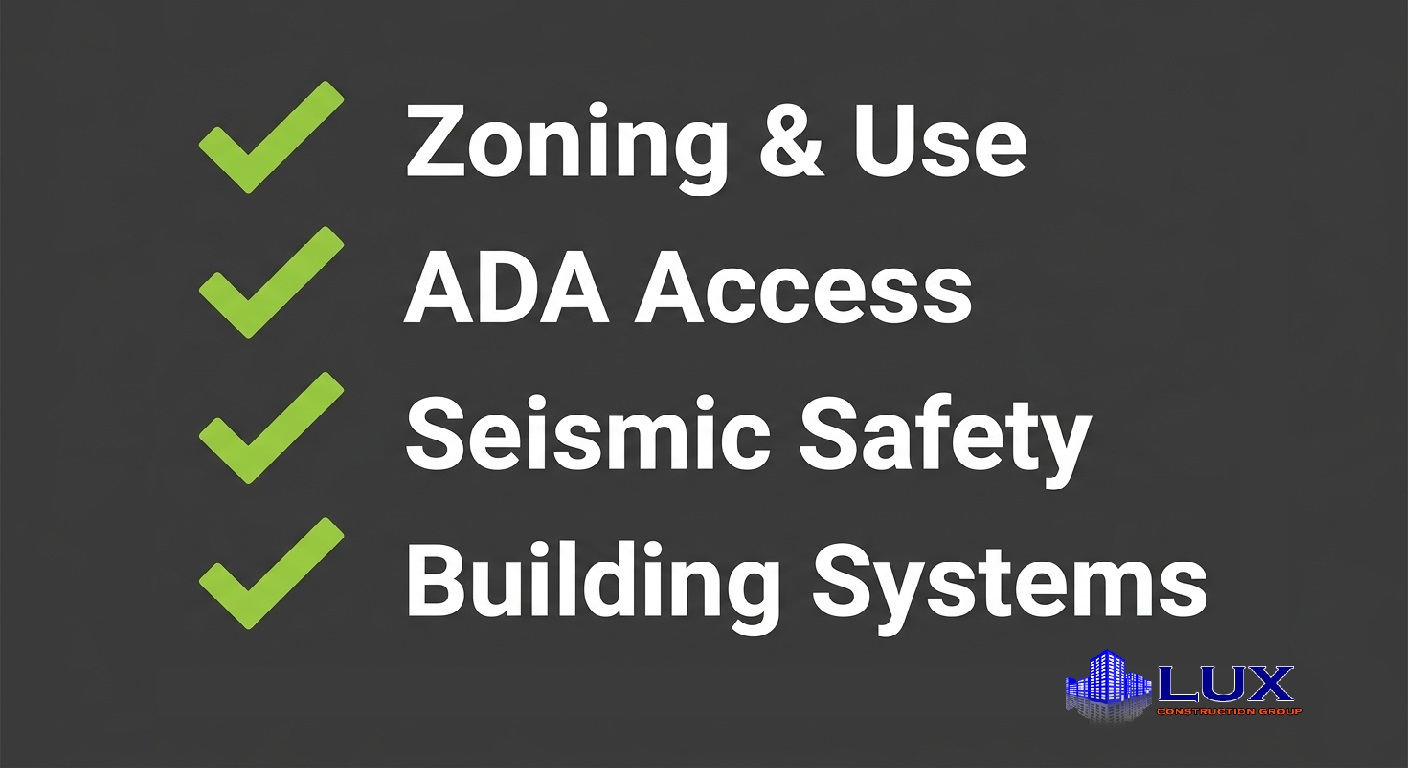
Do your due diligence: Verify these factors before committing to a commercial space.
Check these issues early:
- Zoning and change of use: A space approved for retail may not automatically work for a restaurant, clinic, gym, or assembly-use business. Changing the use can trigger additional review.
- ADA access: Entrances, restrooms, parking, paths of travel, counters, and common areas may need accessibility upgrades.
- Seismic and structural conditions: Older Los Angeles buildings may require closer review before major layout changes, equipment installation, or structural work.
- Fire and life-safety requirements: Exits, alarms, sprinklers, occupancy loads, fire-rated separations, and emergency access can affect the design.
- Existing building systems: Outdated electrical panels, limited plumbing, poor ventilation, or aging HVAC systems can change the scope after demolition begins.
- Special approvals: Restaurants, medical spaces, imaging rooms, and some specialty uses may require additional review beyond a standard building permit.
Owners should confirm these issues before signing a lease, finalizing a budget, or setting an opening date. A space that looks suitable can still become expensive if the required use triggers major upgrades.
For permit-specific planning, review commercial construction permit regulations before construction starts.
How to Choose a Commercial Contractor by Project Type
The right contractor depends on the space being built. A basic office refresh, restaurant buildout, medical office, warehouse renovation, and mixed-use project do not require the same planning, trade coordination, or inspection experience.
For Los Angeles projects, the contractor should also understand local permitting, ADA access, seismic conditions, fire/life-safety requirements, older building limitations, and inspections tied to the building’s use.
Match the contractor’s experience to the project type:
- Restaurant projects: Kitchen layout, exhaust systems, grease management, fire suppression, plumbing, ADA restrooms, and health department coordination.
- Medical and healthcare spaces: Patient flow, equipment clearance, sanitation needs, accessibility, privacy, specialized rooms, and inspection coordination.
- Warehouse and industrial projects: Loading access, racking layouts, floor loads, ventilation, electrical demand, fire protection, and equipment movement.
- Office and tenant improvement projects: Leased-space buildouts, partitions, lighting, HVAC adjustments, restrooms, data cabling, finishes, and landlord requirements.
- Mixed-use projects: Separate occupancies, access points, utilities, fire separation, noise control, parking, and code coordination.
Before hiring a commercial contractor in Los Angeles, ask for examples of similar completed projects, not just general construction experience. The contractor should be able to explain likely permit issues, trade coordination needs, schedule risks, and inspection requirements for your specific commercial type.
Ask these three questions before construction starts:
- What systems or approvals could delay the project?
- What existing building conditions could change the scope?
- What decisions need to be made before pricing, permitting, or scheduling?
FAQs About Commercial Construction Types
What are the main types of commercial construction?
The main types are retail, restaurant, office, medical, industrial, warehouse, hospitality, mixed-use, multifamily, tenant improvement, commercial renovation, institutional, and specialty commercial construction.
What are examples of commercial construction projects?
Commercial construction examples include retail stores, restaurants, offices, clinics, warehouses, hotels, mixed-use buildings, tenant buildouts, manufacturing spaces, and commercial renovations.
Do commercial construction types affect permit requirements?
Yes. Commercial construction types affect permits because building use controls occupancy, fire safety, accessibility, plumbing, electrical, HVAC, and inspection requirements.
What should owners check before leasing a commercial space?
Owners should check zoning, permitted use, utilities, ADA access, fire/life-safety needs, restroom capacity, ventilation, parking, and upgrade costs before signing a lease.
Can one commercial space be converted into another use?
Yes. A commercial space can change use, but conversion may require zoning review, building permits, accessibility upgrades, fire-safety changes, utility work, and inspections.
Which commercial construction type needs the most specialized planning?
Restaurant, medical, mixed-use, warehouse, and industrial projects need specialized planning because systems, equipment, permits, inspections, and daily operations are closely connected.
Is tenant improvement considered commercial construction?
Yes. Tenant improvement is commercial construction because it modifies leased business space for layout, operations, utilities, code compliance, finishes, accessibility, and branding.
Is multifamily considered commercial construction?
Multifamily is residential in use, but it is often treated as commercial real estate when built as an income-producing property with shared systems, fire separation, parking, and long-term maintenance needs.
Which type of commercial construction is the most expensive?
There is no single most expensive type. Cost depends on size, location, systems, finishes, code requirements, and site conditions. Medical, restaurant, hospitality, industrial, and mixed-use projects often need more specialized planning.
When should a contractor be involved in commercial construction planning?
A contractor should be involved before final pricing, permitting, or lease commitment so owners can identify code issues, system upgrades, hidden conditions, and schedule risks early.
Plan Your Commercial Construction Project With Lux Construction Group
The right commercial construction plan depends on the type of space, the building’s existing condition, the systems required, and the approvals needed before opening.
Leading Los Angeles Commercial Constructors such as Lux Construction Group helps business owners, property owners, and developers plan commercial construction, remodeling, tenant improvements, restaurant spaces, medical offices, warehouses, offices, and other business-ready environments.
Planning a commercial construction or remodeling project in Los Angeles? Contact Lux Construction Group to evaluate your project type, layout needs, permit requirements, and construction scope before work begins.