Last Updated on April 11, 2026
Contents
- Creating a Calming Oasis: My Approach to Dental Office Acoustics
- Why Noise Control is Essential for a Periodontal Dentist
- Understanding the Basics: Sound Transmission Class (STC)
- Top Methods for Soundproofing During a Dental Remodel
- Integrating Acoustic Treatments and Sound Masking
- My Commitment to Your Peace of Mind
Creating a Calming Oasis: My Approach to Dental Office Acoustics
Welcome to Luxdevla.com! I am thrilled to share some behind-the-scenes insights into what makes a modern, patient-centered periodontal practice truly special. As a dedicated perio dentist proudly serving Northridge and the surrounding San Fernando Valley communities—including Chatsworth, Porter Ranch, and Reseda—I spend my days focused on improving my patients’ oral health. Whether I am treating advanced gum disease, performing delicate bone grafting, or restoring smiles with dental implants, my primary goal is always to deliver top-tier clinical results.
However, over my years of practice, I have learned that clinical excellence is only one part of the patient experience. The environment where you receive your care is equally important. When you step into my Northridge office, I want you to feel a sense of immediate calm. Achieving this tranquil atmosphere does not happen by accident. It requires thoughtful planning, especially when it comes to managing sound. As I always tell my design and contracting teams: privacy is key in healthcare. Learn the best methods for soundproofing a dental office during a remodel or new construction, because ensuring patient comfort is just as important as the treatments we provide.
Why Noise Control is Essential for a Periodontal Dentist
Let us be honest: a dental office can be a noisy place. Between the hum of ultrasonic scalers used for deep cleanings, the high-pitched whine of dental handpieces, and the constant flow of conversations between staff and patients, the acoustic environment can quickly become chaotic. For someone visiting a perio dentist for an implant procedure or gum surgery, this background noise can be incredibly distracting and even stressful.
Research clearly backs up this observation. According to the National Institutes of Health, approximately 36% of the population suffers from dental anxiety, and the sound of dental equipment is frequently cited as a primary trigger. By proactively managing the noise levels in my clinic, I can significantly lower my patients’ stress levels, making their journey to healthier gums and beautiful implants a much more positive experience. For more information on how environments affect patient anxiety, you can read this comprehensive National Institutes of Health (NIH) research on dental anxiety.
Protecting Your Medical Information
Beyond comfort, there is a very strict legal and ethical reason to focus on acoustics: patient privacy. The Health Insurance Portability and Accountability Act (HIPAA) mandates that medical professionals take reasonable safeguards to protect patient health information. When I am discussing a complex periodontal treatment plan, going over medical history, or discussing financial arrangements with a patient in Northridge, that conversation must remain completely private.
If the walls of a dental office are paper-thin, the person in the waiting room or the adjacent treatment chair might hear every word of a private medical discussion. Proper soundproofing is not just a luxury; it is a critical component of HIPAA compliance. My patients deserve to know that when they share their health concerns with me, those words stay between us.
Understanding the Basics: Sound Transmission Class (STC)
Before we dive into the specific methods of soundproofing, it helps to understand how we measure success. In the world of construction and architecture, sound-blocking ability is measured by a rating called the Sound Transmission Class, or STC. The higher the STC rating, the better the wall is at stopping sound from passing through.
- STC 33: Standard interior home walls. Loud speech can be heard and easily understood.
- STC 40: Loud speech can be heard but is mostly unintelligible.
- STC 45: Loud speech is barely heard.
- STC 50+: Very loud sounds are faint or entirely blocked. This is the gold standard for medical privacy.
During a dental office remodel or new construction, the goal is to bring the walls of the treatment rooms (often called operatories) and consultation rooms as close to an STC of 50 as possible. Below is a visual representation of how different construction techniques improve sound privacy in a clinical setting.
Impact of Construction Upgrades on STC Ratings
Comparing standard walls to soundproofed walls used in high-end dental remodels.
Top Methods for Soundproofing During a Dental Remodel
When upgrading a dental practice, it is much easier to tackle soundproofing while the walls are open. Retrofitting is possible, but new construction or a full remodel gives us the perfect blank canvas. Here are the most effective strategies I look for when building a peaceful periodontal environment.
1. Upgrading the Walls: Mass and Decoupling
Sound travels through the air and through solid structures. If you simply put up standard drywall on a wooden or metal frame, the sound vibrations will hit the drywall, travel directly through the studs, and vibrate out the other side. To stop this, we need two things: mass (to make the wall heavier) and decoupling (to break the physical connection between the rooms).
During my office renovations, I ensure the walls separating the treatment rooms use a staggered stud technique. Instead of sharing a single row of wooden or metal studs, the wall uses two offset rows. This means the drywall on the left side of the room does not touch the same studs as the drywall on the right side. When a dental drill makes a noise, the vibration stops at the stud because there is a physical break in the structure.
We also fill the empty cavity inside the walls with acoustic mineral wool insulation. Unlike standard pink thermal fiberglass, mineral wool is dense and heavy, specifically designed to trap sound waves. Finally, we apply a double layer of thick, 5/8-inch drywall, joined together with a special acoustic damping compound known as “Green Glue.” This compound converts sound vibrations into tiny amounts of heat, neutralizing the noise before it can escape the room.
2. The Ceiling Challenge: Stopping “Flanking” Sound
One of the biggest mistakes in dental office design is building amazing, soundproof walls that stop right at the drop ceiling. The space above the ceiling tiles, known as the plenum, is typically completely open to allow for HVAC ductwork, plumbing, and electrical wiring. If the walls do not extend all the way up to the true roof deck, sound will simply bounce up, travel over the wall through the plenum, and drop down into the next room. This is known as “flanking.”
To fix this during a remodel, I insist on installing plenum barriers. These are heavy curtains made of Mass Loaded Vinyl (MLV) or foil-faced insulation that hang above the ceiling line, continuing the wall’s barrier all the way to the roof. Additionally, swapping out standard, lightweight ceiling tiles for specialized acoustic tiles with a high Ceiling Attenuation Class (CAC) rating makes a massive difference in keeping conversations isolated.
3. Sealing the Doors and Windows
A wall with an STC rating of 50 is virtually useless if you leave a massive gap under the door. Sound acts like water; it will find the path of least resistance and flow right through it. Standard hollow-core interior doors do very little to stop noise. In a high-quality dental office, replacing these with solid-core wood doors or heavy glass doors is a must.
Furthermore, adding automatic door bottoms and perimeter acoustic seals ensures that when the door clicks shut, the room is completely sealed. An automatic door bottom is a clever device hidden inside the bottom edge of the door. When the door closes, a small plunger hits the door frame, dropping a heavy neoprene seal tightly against the floor. When the door opens, the seal lifts up, so it does not scrape across the beautiful floors of my Northridge clinic.
Integrating Acoustic Treatments and Sound Masking
Soundproofing keeps noise from leaving a room, but we also need to consider the echo inside the room itself. Hard surfaces are everywhere in a dental office: tile floors, solid surface countertops, glass partitions, and leather dental chairs. These surfaces are vital for maintaining the strict infection control standards we follow in periodontics, but they cause sound to bounce around mercilessly.
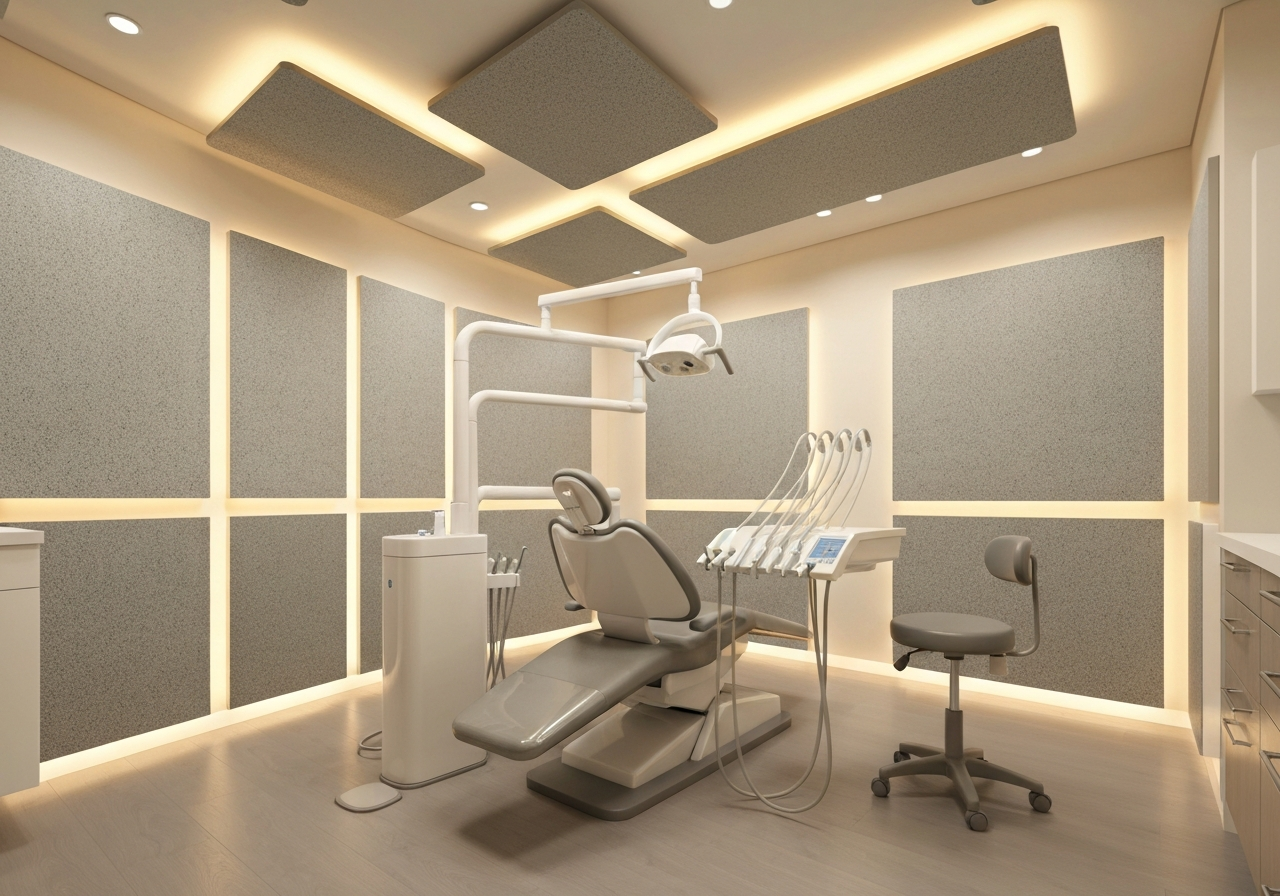
To soften the environment, I like to use acoustic treatments. These are aesthetic additions that absorb echoes. Custom-printed acoustic panels that look like beautiful modern art pieces can be hung on the walls. These panels contain dense foam that traps the higher frequencies of dental instruments, making the room feel warmer and quieter without compromising our clinical sanitation protocols.
The Power of Sound Masking
Even with the best construction in the world, the human ear is incredibly sensitive to distinct noises, like a voice or a ringing phone. This is where active sound masking comes into play. Sound masking systems involve a network of small speakers placed discreetly in the ceiling throughout the waiting areas, hallways, and clinical spaces. These speakers emit a gentle, specifically tuned background noise that sounds similar to soft airflow.
The results of this technology are astounding. Adding a commercial sound masking system can increase an office’s Speech Privacy Class (SPC) rating to over 75, which means conversations outside the treatment room are completely unintelligible. The masking sound effectively raises the ambient noise floor of the clinic, effortlessly burying the sounds of speech and dental tools so patients simply do not notice them.
My Commitment to Your Peace of Mind
As a perio dentist based in Northridge, my daily focus revolves around health, healing, and restoring function. When a patient comes to me from Granada Hills, Woodland Hills, or anywhere else in the San Fernando Valley for a gum graft or a full arch of dental implants, I know they are placing immense trust in my hands.
I take that trust very seriously, which is why I care so deeply about the physical space where my practice operates. Remodeling a dental office to be acoustically sound is a heavy investment of time and resources, but the payoff is immediate the moment a patient sits in the chair, takes a deep breath, and realizes they feel genuinely relaxed.
By blending top-tier acoustic construction techniques—like decoupled walls, mineral wool insulation, and solid doors—with modern sound masking technology, we create a sanctuary for dental health. You no longer have to listen to the anxieties of the past. Instead, you can enjoy a peaceful, private visit while we work together to give you the healthy, radiant smile you deserve.
If you are in the Northridge area and are looking for a periodontal practice that truly values your comfort, your privacy, and your overall well-being, I invite you to visit us at Luxdevla.com. I look forward to welcoming you into our calm, quiet, and caring environment soon.